
Laminate Flooring AC Rating: AC3 vs AC4 vs AC5 for Importers
When comparing laminate flooring suppliers, importers often see AC3, AC4 and AC5 listed prominently in product catalogs and quotations. These ratings are useful, but they do not tell the whole story.
A higher AC number generally indicates a higher level of resistance to surface abrasion under the relevant test conditions. However, it does not automatically mean that the flooring has a stronger locking system, a denser HDF core, better moisture resistance or a longer service life in every installation environment.
For buyers sourcing laminate flooring for distributors, retail channels or commercial projects, understanding the difference between AC3, AC4 and AC5 is an important first step. The next step is knowing how to verify the rating and compare it with the rest of the product specification.
This guide explains what laminate flooring AC ratings mean, how AC3, AC4 and AC5 are commonly positioned in the market, and what importers should confirm before placing a bulk order.
1. What Does the AC Rating Mean in Laminate Flooring?
AC stands for Abrasion Class. In laminate flooring, the AC rating is used to describe the abrasion resistance of the surface under specified test conditions.
The surface of laminate flooring is designed to withstand everyday use, including foot traffic, furniture movement and repeated contact with shoes or other objects. Over time, these activities can affect the appearance and condition of the decorative layer.
The AC classification gives buyers a reference point when comparing the abrasion resistance of different laminate flooring products.
In general, a higher AC category indicates a higher level of abrasion resistance under the relevant testing conditions. This is why AC3, AC4 and AC5 are frequently highlighted in product catalogs, technical data sheets and supplier quotations.
However, AC rating should not be confused with overall product quality.
It does not independently establish:
The density or consistency of the HDF core
The strength of the click locking system
The dimensional stability of the plank
The product’s resistance to moisture
Its resistance to impact or heavy rolling loads
The expected service life under every installation condition
For importers, AC rating is one important part of the technical specification, not a complete quality assessment.
Buyers comparing different product ranges can start with the SENOINFI Laminate Flooring collection and then evaluate individual products according to their intended market and application.
2. AC3 vs AC4 vs AC5: What Are the Main Differences?
AC3, AC4 and AC5 are commonly used categories in the laminate flooring market. They help buyers distinguish products with different levels of surface abrasion resistance.
The following table provides a general purchasing reference.
| AC Rating | Common Market Positioning | Typical Purchasing Consideration |
|---|---|---|
| AC3 | General residential use | Often considered for standard residential flooring ranges |
| AC4 | Higher abrasion resistance | Commonly considered for busy residential areas and selected commercial applications |
| AC5 | Higher abrasion resistance for demanding use | Often considered for projects with more demanding surface wear requirements |
These descriptions reflect common market positioning. They should not be treated as universal application rules or a replacement for the relevant test report and use classification.
AC3 Laminate Flooring
AC3 laminate flooring is commonly positioned for residential applications.
It may be considered for bedrooms, living rooms, private apartments and other areas where daily foot traffic is relatively moderate.
For distributors serving residential customers, AC3 can provide an option for buyers who are more price-sensitive and do not require a higher abrasion-resistance category.
However, AC3 should not automatically be described as a low-quality product. Its suitability depends on the complete product construction, manufacturing consistency and intended application.
Importers should still check the HDF core, locking profile, surface finish and relevant technical documentation before making a purchasing decision.
AC4 Laminate Flooring
AC4 laminate flooring is often selected when buyers require a higher level of surface abrasion resistance than standard residential products.
It is commonly considered for busy residential areas and selected commercial applications. For distributors, AC4 can also be a practical middle option between entry-level residential products and higher-specification ranges.
This makes AC4 a useful category to evaluate when building a product range for different customer groups.
However, an AC4 label alone does not establish that a product is suitable for every shop, office, hotel or public building. Buyers should check the declared use class and other relevant performance requirements.
AC5 Laminate Flooring
AC5 laminate flooring is generally positioned for applications with more demanding surface wear requirements.
It may be considered for certain commercial projects where foot traffic and daily surface use are expected to be relatively high.
However, a higher AC rating does not guarantee that the flooring is suitable for every commercial environment.
Areas exposed to heavy rolling loads, repeated impacts, moisture or unusual cleaning conditions may require additional performance checks. The buyer should consider the complete product specification and the actual conditions of use.
For project buyers, the decision to specify AC5 should be based on documented performance requirements rather than simply choosing the highest number in a supplier’s catalog.
3. AC Rating and Use Class Are Not the Same
One of the most common mistakes in laminate flooring purchasing is treating AC rating and use class as interchangeable terms.
They are related, but they describe different aspects of product performance.
AC rating focuses on the abrasion resistance of the laminate flooring surface.
Use class indicates the intended level and category of use under the relevant classification system.
Use classes such as 21, 22 and 23 are associated with domestic applications, while classes such as 31, 32 and 33 are associated with commercial applications at different levels of use.
For laminate flooring, EN 13329 provides product requirements, test methods and classification information. Its classification system is linked to EN ISO 10874.
Importers can refer to the Swedish Institute for Standards — SS-EN 13329:2024 for information about the standard’s scope.
The NEN information page for EN 13329:2024 also provides information about the standard and its relationship with EN ISO 10874.
When comparing supplier quotations, buyers should request both the AC rating and the declared use class where applicable.
For example, a quotation that only states “AC4 laminate flooring” does not provide enough information to evaluate the complete product specification or confirm its suitability for a particular commercial project.
The intended application, relevant classification and supporting test documentation should all be considered together.
4. Does a Higher AC Rating Always Mean Better Laminate Flooring?
Not necessarily.
A product with a higher AC rating may offer greater abrasion resistance, but that does not mean it will outperform another product in every aspect.
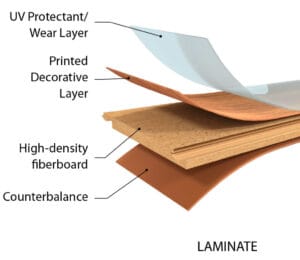
Laminate flooring is a multi-layer product. Its overall performance depends on several components working together.
HDF Core Quality
The HDF core provides the structural base of laminate flooring.
Buyers should pay attention to core density, consistency, dimensional stability and the manufacturer’s agreed technical specification.
A product with a high AC rating may still have problems if the HDF core is inconsistent or does not meet the required specification.
For bulk purchasing, importers should confirm the core specification and check whether the delivered product matches the approved sample.
Locking System Strength
The locking profile affects how securely the planks connect during installation and how well the joints perform under normal use.
Importers should check joint fit, profile consistency and locking performance rather than judging the product only by its surface rating.
Poorly manufactured locking profiles can create installation difficulties or joint-related problems even when the surface has a relatively high abrasion rating.
Moisture Resistance
Standard laminate flooring should not automatically be described as waterproof.
Its performance around water depends on the core material, joint design, surface treatment, installation details and manufacturer’s instructions.
For markets where customers frequently clean floors with water or where humidity conditions vary, moisture-related performance deserves particular attention.
Buyers should request specific test information rather than relying on general descriptions such as “water-resistant” or “moisture-proof.”
Surface Appearance and Finish
Abrasion resistance is not the only factor affecting the appearance of a laminate floor.
Buyers may also need to assess:
Scratch resistance
Stain resistance
Surface texture and embossing
Gloss consistency
Resistance to common household chemicals
Decorative paper and colour consistency
A higher AC rating should therefore be considered alongside the other technical properties that matter to the target market.
5. How Should Importers Match AC Ratings with Different Applications?
The right product specification depends on the actual use of the space, not just the project name.
For example, a residential apartment and a hotel corridor may both be described as flooring projects, but their traffic patterns and maintenance requirements can be very different.
Residential Apartments
For standard apartments, buyers may prioritize appearance, price, installation convenience and suitable surface durability.
An AC3 or AC4 product may be considered depending on the target customer, expected foot traffic and local market requirements.
For buyers sourcing products for apartment developments, the 8mm Laminate Flooring for Apartments page provides an example of a residential product application.
The product thickness and AC rating should be specified separately. An 8mm product is not automatically AC3 or AC4.
Hotels and Hospitality Projects
Hotel rooms, corridors, reception areas and shared facilities do not experience the same level of use.
A hotel bedroom may have different performance requirements from a busy corridor or reception area. Importers should avoid specifying one AC rating for every part of a project without checking the actual conditions.
For hospitality sourcing, it is useful to compare the intended application with the complete product specification.
SENOINFI also has a product page covering 8mm Laminate Flooring for Hospitality Projects.
This page is an application example; the thickness itself should not be interpreted as evidence of a particular AC rating.
Retail Stores and Commercial Interiors
Retail stores may experience frequent foot traffic, movement of display equipment and repeated cleaning.
For these projects, buyers should consider abrasion resistance together with use class, impact performance, surface maintenance and expected operating conditions.
The 10mm Laminate Flooring for Retail Interiors page provides another example of a product application.
Importers should confirm the actual AC rating and use class of the selected product rather than assuming them from the product thickness.
Offices and Other Commercial Spaces
Offices can have different requirements depending on the number of employees, visitor traffic, chair movement and furniture layout.
A private office, meeting room and shared working area may not require the same specification.
For buyers reviewing products for office projects, the 12mm Laminate Flooring for Office Projects page can be used as an application reference.
Again, 12mm thickness does not automatically mean AC5 or establish a commercial use class.
6. What Should Importers Check Besides the AC Rating?
When evaluating a laminate flooring supplier, importers should review the complete technical specification instead of relying on one performance label.
The following points are worth checking before sample approval or mass production.
| Item | What Buyers Should Confirm |
|---|---|
| AC rating | Declared abrasion-resistance category and supporting test documentation |
| Use class | Intended domestic or commercial application |
| Total thickness | Actual product thickness and permitted tolerance |
| HDF core | Core specification, consistency and dimensional stability |
| Locking system | Profile design, joint fit and locking performance |
| Surface finish | Texture, gloss level, stain resistance and appearance |
| Moisture performance | Test method, result and limitations of use |
| Product dimensions | Length, width and thickness tolerances |
| Packaging | Carton quantity, pallet details and shipping protection |
| Documentation | Technical data sheet, test reports and agreed product specification |
Buyers should also make sure that the technical data sheet, approved sample and purchase order describe the same product.
If a supplier quotes AC4 flooring but the test documentation relates to another construction or product series, the importer should request clarification before confirming the order.
7. How Can Buyers Verify an AC Rating?
A product label or supplier quotation is not enough to establish the actual abrasion performance of a laminate flooring product.
Before placing a large order, importers should request documentation that identifies the tested product and the relevant test method.
A useful verification process includes the following steps.
Step 1: Request the Technical Data Sheet
The document should identify the product construction, thickness, surface specification, AC rating and use class where applicable.
Check whether the information is specific to the product being quoted or only describes a general product range.
Step 2: Request the Relevant Test Report
Check the report issuer, test date, product identification, test method and reported result.
The report should relate to the product being purchased, not simply another product from the same factory.
If the report does not clearly identify the tested construction or product series, ask the supplier for clarification.
Step 3: Compare the Report with the Approved Sample
The surface, thickness, core construction and locking profile should correspond to the product that will be manufactured.
A sample that looks similar to the catalog image is not enough. Buyers should confirm that the sample represents the actual product specification.
Step 4: Confirm the Agreed Specification in Writing
The purchase order or technical agreement should clearly state:
Required AC rating
Use class, where applicable
Total thickness and tolerances
HDF core specification
Surface finish and design
Locking profile requirements
Packaging details
Required test documents
The EN 13329 standard information published by the Swedish Institute for Standards is a useful reference for understanding the scope of laminate flooring specifications and test methods.
The public description of the standard is not a replacement for the full technical standard or an actual product test report.
8. Consider Regional Market Requirements Before Choosing AC3, AC4 or AC5
The best product mix can differ between countries and customer groups.
Importers should consider local purchasing habits, project requirements, price levels and the types of buildings commonly served by their distribution network.
Central Asia: Kazakhstan, Uzbekistan, Turkmenistan and Tajikistan
In Central Asian markets, importers may serve residential construction, apartment renovation, local building material retailers and commercial projects.
Rather than assuming that every customer requires AC5, distributors can evaluate demand across different product categories.
For example, a product range may include:
An entry-level residential option
A mid-range product for broader residential demand
A higher-specification option for selected commercial projects
Buyers should also consider transportation, storage conditions, seasonal temperature changes and installation practices when assessing product suitability.
For a laminate flooring importer in Kazakhstan or a building material supplier in Uzbekistan, the practical decision is to match the product specification with local customer requirements rather than choosing an AC rating based on the number alone.
The same approach applies to distributors in Turkmenistan and Tajikistan, where product selection should reflect the actual customer base and project specifications.
South America
South American markets are diverse, and requirements can vary between countries, cities and customer segments.
A distributor supplying residential renovation customers may need a different product mix from a company focused on retail stores, offices or hospitality projects.
For importers, the practical approach is to collect feedback from local customers and match product specifications to actual demand.
AC rating should be one part of this process, alongside price, design, dimensions, packaging and installation requirements.
Other Export Markets
In other regions, buyers may face different standards, project specifications or customer expectations.
Importers should confirm whether the buyer, contractor or local authority requires a particular test method, classification or supporting document before ordering.
A product specification that works in one market should not automatically be assumed to meet the requirements of another.
9. Common Mistakes When Buying AC3, AC4 and AC5 Laminate Flooring
Several purchasing mistakes can create unnecessary costs or disputes after the goods arrive.
Choosing AC5 Simply Because It Is the Highest Rating
A higher rating may not be necessary for every application.
Buyers should match the product to the expected use and project requirements. Selecting a higher category without a clear reason may increase purchasing costs without providing a meaningful benefit for the intended customer.
Assuming AC Rating and Use Class Are Interchangeable
They describe different performance aspects.
Importers should check both rather than accepting one as a substitute for the other.
Assuming Thicker Flooring Has a Higher AC Rating
An 8mm, 10mm or 12mm product does not automatically correspond to AC3, AC4 or AC5.
Thickness and abrasion resistance should be specified and verified separately.
Relying Only on a Supplier’s Catalogue
A catalogue is useful for product selection, but it does not replace a technical data sheet or relevant test report.
Buyers should request supporting documentation for the exact product being quoted.
Ignoring the Locking System and Core Quality
Surface abrasion resistance cannot compensate for inconsistent core material, poor profile machining or unsuitable joint performance.
The complete construction should be reviewed before a bulk order is confirmed.
Not Confirming the Approved Sample Before Production
A bulk order should follow the agreed product specification and approved sample.
Otherwise, differences in surface appearance, dimensions or construction may become difficult to resolve after delivery.
10. A Practical Checklist Before Placing a Bulk Order
Before confirming a laminate flooring order, importers can use the following checklist:
Confirm the required AC rating for the intended application.
Confirm the use class where applicable.
Obtain the product technical data sheet.
Request relevant abrasion-resistance test documentation.
Verify that the test report identifies the correct product.
Confirm thickness, dimensions and permitted tolerances.
Check HDF core specifications and locking profile details.
Review surface finish, colour and texture against the approved sample.
Confirm packaging, carton quantity and pallet requirements.
Record all agreed specifications in the purchase order.
For distributors managing several product ranges, it may also be useful to compare available 12mm Laminate Flooring Wholesale options when planning a product assortment.
The objective is not to select the highest AC rating for every order. It is to make sure that the product specification is appropriate for the customer, application and market.
11. Discussing Laminate Flooring Specifications with a Manufacturer
For importers and distributors, selecting laminate flooring is a matter of balancing performance, product positioning and purchasing cost.
AC3, AC4 and AC5 provide useful reference points when comparing surface abrasion resistance. However, the final purchasing decision should also consider use class, core construction, locking performance, surface finish, moisture-related requirements and supporting test documentation.
SENOINFI supplies laminate flooring options for different market and project requirements. Buyers can discuss product thickness, surface designs, technical specifications, packaging and OEM requirements before confirming samples and bulk orders.
If you are comparing AC3, AC4 or AC5 laminate flooring for distribution or a specific project, you can contact the SENOINFI team with your target application and required specifications.
Providing the intended application, preferred thickness, surface design and target market helps make the product comparison more practical before moving to sample approval and production.