
Laminate Flooring HDF Core Density: What Importers Should Check Before Ordering
When comparing laminate flooring suppliers, buyers often focus on thickness, AC rating, surface design, and price.
However, understanding laminate flooring HDF core density receives less attention, even though the laminate flooring HDF core plays a vital role in structural performance and overall laminate flooring core quality.
For importers, distributors, and project buyers, understanding laminate flooring HDF core density is useful when comparing products from different manufacturers. However, density alone cannot tell you whether a laminate floor will perform well after installation.
A board with a higher density is not necessarily a better product. Core bonding, moisture-related performance, dimensional stability, and the quality of the click profile also need to be considered.
This guide explains what HDF density means, how it is tested, and what buyers should confirm before approving a supplier or placing a bulk order.
1. What Exactly Is the HDF Core in Laminate Flooring?
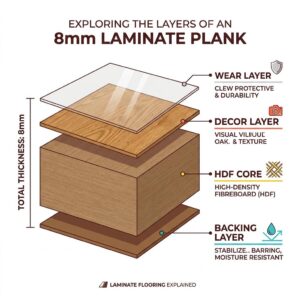
HDF stands for High-Density Fibreboard. It is a wood-based panel made by breaking wood materials into fibres, combining them with adhesive, and pressing them under controlled heat and pressure.
In laminate flooring, the HDF core sits beneath the decorative surface layers and above the balancing layer. It forms the main structural body of the plank.
The core has several important functions:
-
Providing support for the decorative surface
-
Maintaining the shape and stability of the plank
-
Carrying the click-locking profile
-
Contributing to the overall strength of the flooring
-
Affecting how the product responds to changes in moisture and indoor conditions
This is why two laminate flooring products with the same nominal thickness and similar surface appearance may perform differently.
For buyers, checking the core specification is an important part of evaluating the product, particularly when sourcing large quantities for distribution or commercial projects.
2. What Does HDF Core Density Actually Mean?
Density describes how much material is contained in a given volume. For HDF, it is normally expressed in kilograms per cubic metre (kg/m³).
In simple terms, density is calculated by dividing the mass of a test specimen by its volume.
The commonly referenced test methods include EN 323 and ISO 9427. Both provide methods for determining the density of wood-based panels. Buyers should confirm which method the supplier uses and whether the reported result can be traced to the tested material and production batch.
You can refer to the ISO 9427 standard for information about the determination of density in wood-based panels.
It is important to distinguish between the density of the raw HDF board and the performance of the finished laminate flooring. A density result is a material measurement; it does not directly represent every aspect of the finished plank’s performance.
When reviewing a supplier’s technical data, ask for:
-
The reported density in kg/m³
-
The test method used
-
The tested board thickness
-
The sampling and testing date
-
The production batch or material identification
A density figure without test details is difficult to compare with another supplier’s data.
3. Does Higher Density Always Mean Better Laminate Flooring?
Not necessarily.
Density is one useful indicator of HDF core characteristics, but it should not be treated as a complete quality grade.
A higher-density board may offer certain structural advantages, but the final result also depends on fibre quality, adhesive bonding, pressing conditions, moisture content, and manufacturing consistency.
For example, a core with a high reported density may still have unsatisfactory internal bonding or moisture-related performance. Similarly, a product with a moderate density may perform well when its other material properties and manufacturing controls are properly managed.
Importers should therefore avoid choosing a supplier based on one density number.
It is also worth evaluating the surface wear performance separately. HDF core quality and surface abrasion resistance are different aspects of laminate flooring. Our laminate flooring AC rating guide explains how AC3, AC4, and AC5 relate to different use requirements.
When comparing suppliers, review the core material and surface specification as two connected but separate parts of the product.
4. Thickness vs. Density: Don’t Confuse the Two
Thickness and density are often discussed together, but they measure different things.
-
Thickness refers to the physical height of the flooring plank.
-
Density refers to the mass of material within a given volume.
A 12 mm laminate flooring product is not automatically denser or stronger than an 8 mm product. The difference in thickness may affect the overall construction, feel underfoot, and suitability for certain applications, but it does not establish the density or internal quality of the HDF core.
For this reason, buyers should compare products with the same nominal thickness and construction whenever possible.
If you are reviewing different product options, you can also refer to our specifications for 8 mm laminate flooring, 10 mm laminate flooring, and 12 mm laminate flooring.
When requesting technical data, make sure the supplier identifies whether the figures refer to the HDF core board or the complete finished flooring plank.
5. Why HDF Quality Matters for the Click Locking System
The click profile is cut directly into the core of many laminate flooring products. Its performance depends on more than the nominal density of the board.
The core needs sufficient strength and consistent internal bonding to help the locking profile remain intact during installation and normal use.
If the core material is inconsistent, or if the profile is poorly machined, buyers may encounter problems such as:
-
Chipped or damaged locking edges
-
Difficulty joining planks during installation
-
Loose connections between adjacent planks
-
Gaps appearing after installation
-
Breakage around the locking area
These issues do not always originate from density. Manufacturing accuracy, profile design, machining quality, installation conditions, and handling can also contribute.
For importers, it is useful to inspect full-length planks rather than relying only on small samples. Ask the supplier to demonstrate the locking system and check whether the joints remain tight after repeated assembly and disassembly, where this is appropriate for the product design.
6. Moisture Performance: Why Thickness Swelling Should Be Checked Separately
Density and moisture performance are related material considerations, but they are not interchangeable.
Thickness swelling measures how much a board increases in thickness after exposure to specified moisture conditions. EN 317 is a commonly referenced method for determining thickness swelling after immersion in water.
A density report cannot replace a thickness swelling test.
For laminate flooring buyers, this distinction matters because the finished product may be exposed to changes in indoor humidity, cleaning practices, accidental spills, or unsuitable installation conditions.
When reviewing a supplier’s test report, check:
-
The thickness swelling result
-
The test method and test duration
-
The thickness of the tested HDF board
-
Whether the result refers to the core material or finished flooring
-
Whether the reported value matches the agreed product specification
The Wood Panel Industries Federation’s standards and codes of practice provide additional reference material on wood-based panel testing and related requirements.
Do not assume that a standard HDF core is waterproof simply because its density is high. Conventional HDF-based laminate flooring should be installed and maintained according to the manufacturer’s instructions, with particular attention to moisture exposure and perimeter protection.
7. Other HDF Core Properties Worth Checking
Density is only one part of the technical evaluation. Importers should also review several other properties when assessing the quality of the HDF core.
Internal Bond Strength
Internal bond strength measures the tensile strength perpendicular to the plane of the board. It provides information about how well the fibres are bonded within the core.
EN 319 is a commonly used test method for this property.
Bending Strength and Modulus of Elasticity
These properties help describe how the board responds to bending forces and how stiff it is.
EN 310 is commonly used to determine bending strength and modulus of elasticity.
Moisture Content
Moisture content affects the condition of the board and should be checked as part of material quality control. EN 322 provides a method for determining the moisture content of wood-based panels.
Dimensional Stability
Changes in relative humidity can cause wood-based panels to change dimensions. EN 318 provides a method for determining dimensional changes associated with changes in relative humidity.
The European Panel Federation’s technical information on assessing panel properties is a useful reference for understanding these different material characteristics.
When comparing test reports, make sure the values refer to the same HDF thickness and product specification. Results from different thicknesses, grades, or test conditions should not be treated as directly comparable.
These test methods help buyers understand different material properties. They do not, by themselves, establish a universal pass level for every laminate flooring product. Acceptance limits should be agreed according to the product specification, applicable requirements, and intended use.
8. A 5-Step HDF Verification Checklist for Importers
Before confirming a bulk order, buyers can use the following checklist to review the supplier’s HDF core quality.
Step 1: Confirm the Core Specification
Ask for the HDF core thickness, density range, and relevant material information. Confirm whether the figures refer to the core board or finished plank.
Step 2: Request Supporting Test Reports
Where available, request test results for density, internal bond strength, thickness swelling, moisture content, and bending properties.
Check the test methods, test dates, sample descriptions, and whether the results can be linked to the production material.
Step 3: Inspect the Click Profile
Check the locking edges for clean machining, visible damage, and consistency. Assemble several planks and inspect the joints.
Step 4: Compare Samples with the Agreed Specification
Do not approve a sample based only on colour and surface appearance. Confirm the thickness, core construction, locking profile, and other agreed technical details.
Step 5: Keep a Reference Sample for Bulk Production
Retain an approved sample and record the product specification. This gives both the buyer and supplier a reference when checking mass production and handling any quality claims.
9. What Importers Should Confirm Before Ordering
The right HDF specification depends on the product, target market, application, and expected price level. There is no single density figure that is suitable for every laminate flooring order.
For importers supplying Canada, indoor heating during colder periods and seasonal changes in humidity make it important to consider product acclimation, subfloor conditions, and installation instructions. Buyers should not assume that a higher-density core alone will prevent dimensional movement.
For Central Asian markets such as Kazakhstan, Uzbekistan, and Turkmenistan, buyers may be supplying distributors and projects across regions with significant seasonal temperature differences. It is worth confirming the manufacturer’s storage, transportation, acclimation, and installation recommendations, as well as the product’s technical test results.
In South America, market conditions can vary considerably between countries and regions. Buyers sourcing for Chile, Peru, or Brazil should consider the intended application and local installation environment rather than treating the region as one uniform climate. For projects in coastal or more humid locations, moisture management and installation details deserve particular attention.
Across all these markets, the same purchasing principle applies: evaluate the complete flooring specification instead of selecting a product based on HDF density alone.
Before placing an order, confirm the following details with the manufacturer:
-
Nominal flooring thickness and HDF core thickness
-
HDF density and agreed tolerance, if specified
-
Internal bond and other relevant mechanical test results
-
Thickness swelling and moisture-related test information
-
Surface wear rating and decorative finish
-
Click profile design and dimensional tolerances
-
Packaging, storage, and installation recommendations
-
Approved sample and production inspection requirements
A clear specification helps reduce misunderstandings between the supplier and importer, especially when the order involves multiple thicknesses, designs, or destination markets.
For product details and available options, visit our laminate flooring range. If you are comparing specifications for an upcoming order, you can also contact our team to discuss the required construction, thickness, and technical details.