


Choosing the right flooring material is an important decision for importers, distributors and project buyers.
Different flooring types offer different advantages in terms of:
- Waterproof performance
- Durability
- Installation method
- Cost
- Maintenance requirements
- Application suitability
Among modern flooring solutions, SPC flooring, LVT flooring and laminate flooring are three commonly compared options.
Although they may look similar from a design perspective, their construction and performance characteristics are different.
Understanding these differences helps buyers select the right flooring solution for their target market.
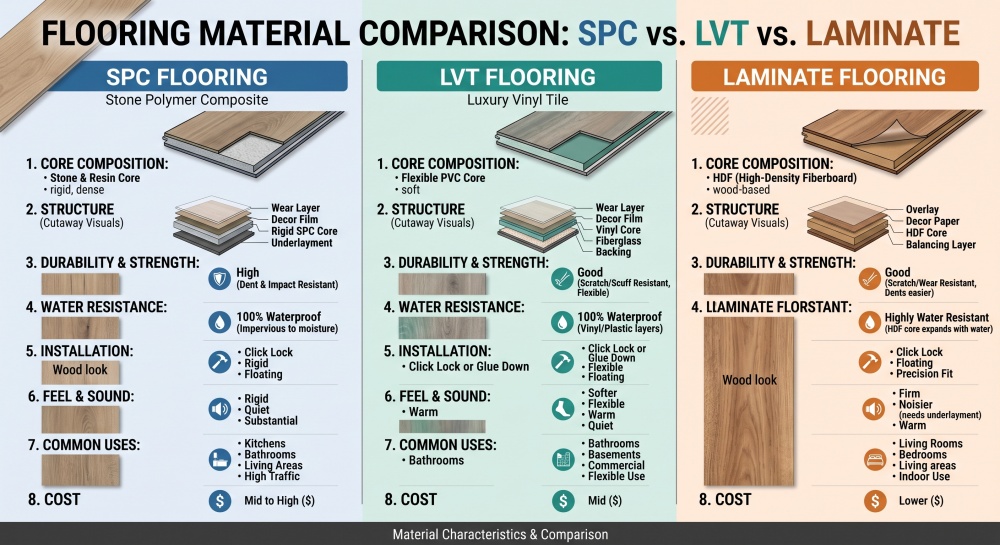
Understanding the Basic Structure
Before comparing performance, it is important to understand the basic construction of each flooring type.
SPC Flooring
SPC (Stone Plastic Composite) flooring is a rigid core flooring product made from:
- Limestone powder
- PVC
- Stabilizers
- Decorative film
- Protective layers
The rigid mineral-based core provides high dimensional stability and water resistance.
Because of its structure, SPC flooring is widely used in:
- Residential projects
- Commercial spaces
- Hotels
- Multi-family housing
For more technical information, see:
SPC flooring: a technical guide to rigid core waterproof flooring
LVT Flooring
LVT (Luxury Vinyl Tile) is a flexible vinyl flooring product.
Typical construction includes:
- Vinyl backing layer
- Decorative layer
- Wear layer
- Protective coating
LVT is popular because of:
- Realistic designs
- Comfortable feel
- Flexible installation options
However, some LVT products require more attention to subfloor preparation because the flexible structure may show surface imperfections.
Laminate Flooring
Laminate flooring normally consists of:
- HDF core
- Decorative paper
- Wear-resistant surface layer
- Protective coating
Laminate is known for:
- Wood-like appearance
- Cost efficiency
- Easy installation
However, traditional laminate has limitations when exposed to moisture.
SPC vs LVT vs Laminate: Performance Comparison
| Feature | SPC Flooring | LVT Flooring | Laminate Flooring |
| Core structure | Rigid mineral core | Flexible vinyl core | Wood-based HDF core |
| Water resistance | Excellent | Excellent depending on construction | Limited compared with SPC |
| Dimensional stability | High | Moderate | Moderate |
| Installation | Click system options | Glue-down or click | Click system |
| Subfloor tolerance | Good | Requires careful preparation | Requires suitable subfloor |
| Maintenance | Easy | Easy | Requires moisture control |
| Commercial use | Excellent | Common | Depends on environment |
Waterproof Performance: SPC Advantage
Water resistance is one of the biggest reasons buyers compare SPC with traditional flooring options.
Because SPC has a mineral-based rigid core, it does not absorb water like wood-based materials.
This makes SPC suitable for areas where moisture resistance is important:
- Kitchens
- Bathrooms
- Commercial spaces
- Hospitality projects
Laminate flooring, especially traditional HDF-based products, requires more attention because moisture can cause swelling.
For a detailed comparison:
SPC Flooring vs Laminate Flooring: A Complete Guide for Importers and Distributors
Durability and Long-Term Performance
For international buyers, durability directly affects customer satisfaction and warranty risk.
SPC Flooring
Advantages:
- High impact resistance
- Stable structure
- Good scratch resistance with proper wear layer
- Suitable for high-traffic environments
The performance depends on:
- Core quality
- Wear layer thickness
- UV coating
- Manufacturing consistency
LVT Flooring
LVT provides excellent design flexibility and comfort.
However, because it has a more flexible structure, buyers should consider:
- Installation conditions
- Traffic level
- Product specification
Laminate Flooring
Laminate can provide good wear resistance and realistic wood appearance.
However:
- Water exposure remains a key consideration
- Quality depends heavily on HDF core performance
Installation Comparison
Installation efficiency is important for contractors and project developers.
SPC Flooring
Common installation methods:
- Click-lock system
Advantages:
- Faster installation
- No adhesive required
- Easier replacement
Learn more:
SPC Flooring Click System Guide
LVT Flooring
Installation methods include:
- Glue-down
- Loose lay
- Click systems
Glue-down LVT can provide excellent stability but usually requires better subfloor preparation.
Laminate Flooring
Laminate commonly uses click installation.
However, installation conditions must control:
- Moisture
- Subfloor flatness
- Expansion requirements
Which Flooring Is Better for Commercial Projects?
There is no single flooring product suitable for every project.
The best choice depends on:
- Traffic level
- Installation environment
- Maintenance requirements
- Budget
- Local market expectations
For many commercial applications, SPC has become popular because it combines:
- Waterproof performance
- Installation efficiency
- Durability
- Design flexibility
For commercial applications, buyers can review:
SPC Flooring for Commercial Projects: A Buyer’s Guide for Architects, Contractors and Developers
Which Flooring Should Importers Choose?
For distributors and importers, the decision should consider the target market.
Choose SPC Flooring When:
- Waterproof performance is important
- Projects require stable performance
- Customers need low maintenance flooring
- Commercial applications are targeted
Choose LVT Flooring When:
- Design flexibility is the priority
- Softer underfoot feel is required
- Specific installation methods are preferred
Choose Laminate Flooring When:
- Cost competitiveness is important
- The market prefers traditional wood appearance
- Moisture exposure is limited
Important Factors Before Purchasing
Professional buyers should not compare products only by price.
Before ordering, evaluate:
Product Specification
Check:
- Thickness
- Wear layer
- Core construction
- Surface treatment
- Backing option
Supplier Capability
Confirm:
- Manufacturing experience
- Quality control process
- Export experience
- Documentation support
A supplier evaluation process can be found here:
SPC Flooring Supplier Checklist
Project Requirements
Different applications require different specifications.
For example:
- Residential apartments
- Hotels
- Retail stores
- Offices
- Healthcare facilities
should not always use the same flooring construction.
SPC, LVT or Laminate: Making the Right Choice
SPC flooring, LVT flooring and laminate flooring each have their own advantages.
The right choice depends on the balance between:
- Performance requirements
- Market positioning
- Budget
- Installation conditions
For many international buyers looking for waterproof, durable and easy-to-install flooring, SPC has become an important option in modern flooring markets.
However, professional sourcing decisions should always be based on complete product specifications and supplier reliability.
SENOINFI Flooring Supply Support
SENOINFI provides SPC flooring solutions for international distributors, importers and project customers.
Our support includes:
- Product specifications
- Samples
- Technical documents
- OEM solutions
- Customized flooring requirements
For buyers comparing SPC flooring with LVT or laminate flooring, we can provide suitable product options according to your market requirements.