


When sourcing SPC flooring, buyers often compare specifications such as thickness, wear layer and click system.
However, the surface technology is also important because it affects product appearance, tactile experience and market positioning.
Two common surface options are:
- Regular embossed SPC flooring
- EIR (Embossed in Register) SPC flooring
For distributors, wholesalers and flooring brands, choosing between these technologies is not simply an aesthetic decision. The surface technology can also influence production complexity, product positioning and purchasing cost.
Understanding how regular embossing and EIR work helps buyers select a flooring specification that matches their target market.
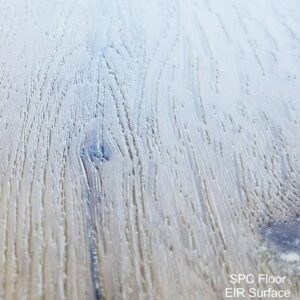
1. What Is Regular Embossed SPC Flooring?
Regular embossing is a conventional surface treatment used in SPC flooring production.
During manufacturing, a textured roller creates a physical pattern on the flooring surface.
The purpose is to add:
- Surface texture
- Visual depth
- A more natural touch
- Wood or stone texture effects
With regular embossed SPC flooring, the surface texture does not necessarily follow the exact pattern of the decorative film underneath.
For example, a decorative film may show a wood knot while the embossed texture does not correspond precisely to the position of that knot.
The result can still provide a realistic wood-look appearance, but the relationship between the printed design and physical texture is less precise.
2. What Is EIR SPC Flooring?
EIR stands for Embossed in Register.
Unlike conventional embossing, EIR technology is designed so that the physical surface texture corresponds with the decorative pattern underneath.
For example:
- A printed wood grain can align with a surface groove
- A wood knot can have a corresponding texture
- Natural grain patterns can match the embossed structure
This creates a closer relationship between what the buyer sees and what they feel when touching the surface.
The result is a more detailed wood-look appearance and a more natural tactile effect.
For buyers developing design-oriented collections, EIR can therefore be an important surface specification.
3. How EIR and Regular Embossing Differ
| Feature | Regular Embossed SPC | EIR SPC Flooring |
| Surface texture | General texture pattern | Texture aligned with decorative pattern |
| Visual effect | Standard wood or stone appearance | More detailed and realistic appearance |
| Tactile effect | Basic textured surface | More natural grain feeling |
| Production complexity | Lower | Higher |
| Pattern alignment | Less precise | More precise |
| Typical positioning | Standard collections | Higher-value collections |
The appropriate technology depends on the product positioning, target market and project requirements.
4. Why Does EIR Require Higher Manufacturing Precision?
One of the main differences between regular embossing and EIR is the level of production control required.
For EIR flooring, the decorative pattern and surface embossing need to align accurately.
This requires control over several production stages.
Printing Accuracy
The decorative film must maintain consistent positioning.
If the printed pattern shifts, the surface texture may no longer match the visual design correctly.
Embossing Alignment
The embossing process must correspond with the decorative pattern.
Small alignment differences can become visible on wood-grain designs, particularly when the product contains detailed knots or grain lines.
Production Consistency
For distributors purchasing multiple containers, consistency is especially important.
The appearance of samples approved before production should remain consistent with the finished production batches.
This is why buyers should evaluate not only the EIR sample but also the manufacturer’s production and quality-control capability.
5. Regular Embossed SPC: When Is It Suitable?
Regular embossed SPC flooring can be a practical choice for many markets.
It may be suitable for:
- Large residential developments
- Rental housing
- Cost-sensitive markets
- High-volume distribution
- Standard flooring collections
Its main advantages include:
- Efficient production
- Broad design availability
- Competitive cost positioning
- Different wood and stone patterns
Common designs include:
- Oak
- Walnut
- Stone
- Concrete
For buyers who prioritize overall product cost and broad design selection, regular embossing can provide a practical solution.
6. When Should Buyers Consider EIR SPC Flooring?
EIR can be considered when surface realism and product differentiation are important.
Typical applications may include:
- Premium residential projects
- Boutique hotels
- Higher-end commercial interiors
- Brand-focused flooring collections
For distributors, EIR can also be used to create a more differentiated product range.
Rather than offering only standard SPC collections, a distributor can combine:
- Standard embossed products
- EIR collections
- Different colors
- Different plank formats
- Different wear layer specifications
This creates a broader product portfolio for different customer segments.
For more information about SPC design options, see:
SPC Flooring Designs: Wood, Stone and Surface Texture Options
7. EIR Surface Technology and Wear Layer Selection
EIR is mainly related to the surface texture and decorative appearance of SPC flooring.
It should not be evaluated separately from the other product specifications.
Buyers should also check:
- Wear layer thickness
- UV coating
- Core construction
- Click system
- Backing material
For example, a realistic EIR surface does not replace the need for an appropriate wear layer.
For a detailed explanation of wear layer specifications, see:
SPC Flooring Wear Layer Guide: 0.2mm vs 0.3mm vs 0.5mm vs 0.7mm Explained for Buyers
8. How EIR Surface Technology Affects SPC Flooring Cost
Surface technology is one of the factors that can influence the factory price of SPC flooring.
A basic specification may use:
- Standard decorative film
- Conventional embossing
- Standard surface treatment
A higher-specification product may include:
- EIR embossing
- More detailed wood textures
- Special surface finishes
- Customized decorative films
However, buyers should not compare prices based on EIR alone.
The complete specification should be compared, including:
- Total thickness
- Wear layer
- Core construction
- Surface technology
- Click system
- Backing
- Packaging
- Order quantity
For a broader explanation of SPC flooring pricing:
How Much Does SPC Flooring Cost? A Pricing Guide for Importers
9. How Should Importers Choose Between EIR and Regular Embossed SPC?
The decision should start with the target market.
Consider Regular Embossed SPC When:
- The market is price-sensitive
- Large-volume residential projects are involved
- Standard designs are sufficient
- Competitive factory pricing is important
Consider EIR SPC When:
- Surface realism is important
- The product targets a higher-value segment
- The distributor wants differentiated collections
- Wood texture is an important selling point
Neither technology should be selected simply because it sounds more advanced.
The correct choice depends on the product positioning and specifications required by the target market.
10. What Should Buyers Ask an SPC Flooring Supplier?
Before placing an order, importers should ask suppliers:
- Is the product regular embossed or EIR?
- How is the decorative film aligned with the embossing?
- What quality-control process is used for EIR production?
- Is the approved sample representative of mass production?
- What wear layer is included?
- What click system is used?
- What backing options are available?
- Can the supplier provide production samples before mass production?
For a broader supplier evaluation process, see:
SPC Flooring Supplier Checklist: 10 Questions Importers Should Ask Before Ordering
EIR SPC Flooring Solutions for Global Buyers
SENOINFI supplies SPC flooring with different surface technologies and product specifications for international buyers.
Available options include:
- Regular embossed SPC flooring
- EIR SPC flooring
- Different thickness options
- Various wear layer specifications
- Click-lock systems
- IXPE and EVA backing
- OEM and private-label solutions
For distributors and flooring brands, EIR can be considered as part of a differentiated product collection, while regular embossing remains suitable for many standard and cost-sensitive applications.
The most appropriate surface technology should ultimately be selected together with the product specification, target market, expected application and overall purchasing cost.