SPC Wall Panel Specifications: A Practical Guide for Importers
When sourcing SPC wall panels from China, buyers need to look beyond the designs shown in a product catalogue. SPC wall panel specifications, including thickness, dimensions, surface finish and installation requirements, all affect whether a product is suitable for a particular project.
These details are easy to overlook during the initial quotation stage. However, once production starts, even a small misunderstanding about panel thickness, colour or dimensions can create unnecessary problems for both the buyer and the manufacturer.
For importers and distributors, it is worth taking the time to get the specifications right before placing an order. This guide covers the main points to consider, from available thicknesses and panel sizes to quality inspection, packaging and supplier selection.
The aim is to make the product requirements clear before production begins, so that the approved sample, purchase order and finished panels all refer to the same specification.
1. What Makes an SPC Wall Panel Different?
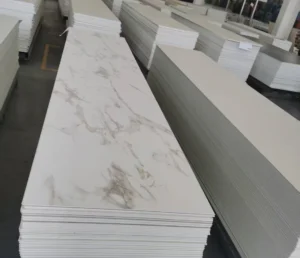
SPC stands for Stone Plastic Composite. It generally refers to a rigid panel made from a PVC-based material combined with mineral fillers, commonly calcium carbonate.
This construction gives the panel its rigidity and allows manufacturers to produce different thicknesses, sizes and decorative finishes. Depending on the surface design, SPC wall panels can reproduce the appearance of marble, natural stone, wood and other decorative materials.
Unlike ceramic tiles, which are installed as individual pieces, SPC wall panels are supplied in larger board formats. This makes them an option for interior wall decoration in residential and commercial spaces.
However, not all SPC wall panels have the same construction or physical properties. Products from different factories may vary in material formulation, density, surface finish, dimensional accuracy and backing structure.
When comparing suppliers, it is therefore better to look at the actual product specifications rather than relying on the name SPC alone.
At a minimum, a quotation should clearly state:
Core material and panel construction
Total panel thickness
Width and length
Surface design and texture
Edge profile and joint treatment
Recommended installation method
Packaging and labelling requirements
Having these details in writing makes it much easier to compare products and avoid misunderstandings later.
2. SPC Wall Panel Specifications: Thickness Options
Thickness is usually one of the first questions importers ask when discussing SPC wall panels. There are several options available, and the right choice depends on the intended application and project requirements.
At SENOINFI, SPC wall panels can be produced in 2 mm, 3 mm, 4 mm, 5 mm and 6 mm thicknesses.
Among these options, 4 mm is a commonly supplied specification and is mainly used for bathroom applications. Thinner and thicker panels can also be produced according to the customer’s requirements.
| Thickness | Production and application notes |
|---|---|
| 2 mm | Available for projects requiring thinner panels |
| 3 mm | Available for different interior wall decoration requirements |
| 4 mm | Commonly supplied, mainly for bathroom applications |
| 5 mm | Available for projects requiring thicker panels |
| 6 mm | Available for projects requiring a thicker panel construction |
These are production options rather than a ranking of product performance. A thicker panel is not necessarily the right choice for every project. Panel size, wall condition, fixing method and transportation requirements should all be considered.
Why is 4 mm commonly used for bathrooms?
Bathroom walls are regularly exposed to moisture and frequent cleaning. For this reason, the panel itself is only one part of the overall specification. The way the joints, corners and edges are finished also matters.
A 4 mm SPC wall panel is a commonly supplied option for bathroom projects at SENOINFI. It offers a practical specification for this type of interior application.
Panel thickness alone does not make an entire bathroom wall waterproof. Water resistance also depends on the panel construction and, just as importantly, the installation details.
Before ordering for a bathroom project, discuss the following with the manufacturer:
Exact panel thickness and construction
Surface and edge suitability
Recommended adhesive or fixing system
Internal and external corner treatments
Joint sealing and cut-edge protection
Installation instructions for wet areas
For shower areas or locations with frequent direct water exposure, the complete installation system needs particular attention.
Does a thicker panel always offer better performance?
Not necessarily. Thickness is only one factor. Material composition, density, flatness and dimensional stability can also influence the finished installation.
If you are comparing 3 mm and 4 mm panels, for example, ask for physical samples of both options. You can then compare their construction and characteristics rather than making a decision based on thickness alone.
The same applies when considering 5 mm or 6 mm panels. Choosing a specification that suits the actual application is more important than simply selecting the thickest available option.
3. SPC Wall Panel Sizes: Width and Length Options
Panel size affects the finished appearance, but it also has practical consequences for transportation, handling and installation.
SENOINFI’s available width options include:
600 mm
1200 mm
Available panel length options include:
2440 mm
2600 mm
2800 mm
3000 mm
The best combination depends on the wall dimensions, room layout and conditions at the installation site. Buyers should confirm the exact width, length and thickness combination with the factory before placing an order.
600 mm or 1200 mm: Which width is more suitable?
A 600 mm panel is relatively easy to handle and can be a practical choice for smaller rooms, narrow corridors and renovation projects where access is limited.
A 1200 mm panel covers a larger area with each board. On wider walls, it can reduce the number of vertical joints and create a more continuous decorative appearance.
The trade-off is handling. Larger panels need more space during transportation and installation, and the installation team may need additional manpower.
For this reason, it is worth considering access routes, lifting conditions and wall flatness before choosing a wider format.
How should panel length be selected?
Longer panels can reduce horizontal joints, particularly on taller walls. However, the available ceiling height and site conditions should guide the final decision.
For example, a 3000 mm panel may work well in a room with high ceilings, while a shorter panel may be easier to handle in apartments or renovation projects with limited access.
For distributors, there is another consideration: the most convenient size for a specific project may not be the best size for regular stock sales. It is worth looking at the common room dimensions and customer preferences in your target market.
Before confirming an order, check the actual dimensions, dimensional tolerances, available thickness and size combinations, cutting allowance and packaging dimensions.
Do not assume that every size can be produced in every thickness automatically. Confirm the exact combination with the factory before issuing the purchase order.
4. Surface Finishes: Why Physical Samples Matter
The surface design is often what attracts a customer to an SPC wall panel in the first place. Marble patterns, stone textures and other decorative finishes give buyers plenty of options for different interior styles.
Common choices include:
Marble-look designs
Natural stone patterns
Wood-effect finishes
Solid colours
Decorative textured surfaces
Some customers prefer a high-gloss marble appearance, while others look for a more understated matte or textured finish.
A product catalogue is useful when narrowing down the options, but it cannot always show the actual colour and texture accurately. Screen settings, lighting and printed images can all affect how a design looks.
For importers, checking a physical sample before production is still one of the best ways to avoid disagreements.
What should you check on a physical sample?
Start with the colour and pattern. Look at the main colour, vein distribution, grain direction and overall appearance. If several panels will be installed together, place them side by side to see how the designs work as a group.
Gloss level is another detail worth checking. A high-gloss finish can look very different from a matte surface, especially under strong indoor lighting.
Pay attention to the texture as well. A smooth marble-effect panel and a textured stone-effect panel are not interchangeable, even if their colours are similar.
For larger orders, pattern consistency should also be discussed. Ask how the factory manages variation between production batches and how multiple cartons will be identified.
Finally, check the panel edges and overall thickness against the agreed specification.
For repeat orders, keep an approved reference sample. Record the colour code, surface finish, thickness and approval date. This gives both sides something concrete to refer to when the next order is placed.
You can also browse the SENOINFI SPC wall panel collection to see available designs and decorative styles.
5. SPC Wall Panels Compared with Other Decorative Wall Materials
SPC wall panels are often compared with ceramic tiles, PVC panels, WPC panels and other decorative wall boards.
Each material has its own characteristics. The right choice depends on the project rather than simply which product sounds better in a quotation.
| Material | General characteristics | Points to consider |
|---|---|---|
| SPC wall panels | Rigid, mineral-filled core with decorative surface options | Check thickness, panel size, joints and installation requirements |
| Ceramic tiles | Hard surface with established tile installation methods | Requires suitable substrate preparation, adhesive and grouting |
| PVC wall panels | Lightweight decorative panels available in various designs | Rigidity and construction vary between products |
| WPC wall panels | Wood-plastic composite construction | Check material composition, moisture behaviour and fixing system |
| Decorative wall boards | A broad category covering different core materials and finishes | Confirm the actual substrate and surface construction |
When comparing prices, remember that product names do not tell the whole story.
For example, a quotation describing a product simply as a waterproof wall panel does not explain its core material, thickness, joint design or installation method.
The same applies to fire performance and environmental claims. If a supplier mentions a particular rating or certification, ask for the corresponding test report and check whether it applies to the actual product being quoted.
6. Where Are SPC Wall Panels Commonly Used?
SPC wall panels are used in a range of residential and commercial interiors. The choice of thickness, dimensions and surface design will depend on the requirements of each space.
Bathrooms
Bathrooms are one of the main applications for decorative SPC wall panels. Marble-look and stone-effect designs are popular choices for modern bathroom interiors.
At SENOINFI, 4 mm is a commonly supplied specification for bathroom projects. Buyers can find more details in our guide to waterproof SPC wall panels for bathrooms.
Hotels and hospitality interiors
Hotels use decorative wall finishes in guest rooms, corridors, reception areas and other public spaces.
For buyers working on hospitality projects, appearance is only part of the decision. Maintenance, cleaning requirements and the availability of matching products for future replacements are also worth considering.
Marble-effect SPC panels may be an option for projects looking to achieve a stone-inspired interior without using natural stone throughout the building.
Retail and commercial interiors
Retail shops, offices and showrooms often use decorative wall panels to create feature walls or maintain a consistent interior style.
For these projects, consider how much contact the walls will receive, how frequently they need cleaning and whether local fire or building regulations apply.
Residential renovation
SPC wall panels can also be used in apartments, villas and other residential properties, including living rooms, bedrooms, kitchens and selected bathroom areas.
In renovation work, the condition of the existing wall is particularly important. Panels should be installed on a suitable, stable surface. Covering a weak or damaged wall does not solve the underlying problem.
7. Installation Starts with the Wall, Not the Panel
Even a well-produced SPC wall panel can give a poor result if the installation conditions are unsuitable.
Before installation, the wall should be checked for flatness, stability, cleanliness and moisture conditions. Dust, grease, loose paint and other contaminants can affect adhesive performance.
The installer should also make sure that the existing wall material is suitable for the chosen fixing method.
Adhesive and fixing method
The right adhesive depends on the panel construction, wall substrate and installation environment. There is no reason to assume that one adhesive will work equally well on every surface.
For larger panels, the installation team should follow the manufacturer’s recommendations for adhesive application, support and curing time.
Joints, corners and edges
The way panels meet at joints and corners has a noticeable effect on the finished appearance. It also matters when moisture resistance is required.
Before placing an order, check whether matching trims, corner profiles, sealants or other accessories are needed.
For bathrooms and other wet areas, these details should be settled before installation begins. A water-resistant panel surface does not automatically make every joint and connection waterproof.
Wall preparation and cutting
Careful measurement and layout planning can reduce cutting waste and help maintain a consistent pattern direction.
Larger panels also need enough space for storage and handling. If you are supplying a project, it is worth discussing these practical requirements with the contractor before the goods leave the factory.
8. Moisture, Fire and Indoor Air Quality: What Documents May Be Required?
Depending on the destination market and project type, importers may need to provide technical documents for SPC wall panels.
The requirements are not the same everywhere. A residential renovation project may have different documentation needs from a hotel or commercial building.
It is best to check the applicable requirements before ordering rather than assuming that one certificate will cover every market.
Moisture and water resistance
Ask the manufacturer about the intended application of the panel and the limits of its water-resistance claims.
For wet-area installations, the joints, corners and pipe openings deserve particular attention. A test report for the panel itself does not prove that the complete installed wall system is waterproof.
Fire performance
Some markets and construction projects require fire-test documentation for interior wall materials.
In the United States, ASTM E84 is a recognised method for evaluating the surface-burning characteristics of building materials. The test reports flame-spread and smoke-developed indices under specified conditions.
You can read more about the method in the ASTM E84 standard.
One important point: ASTM E84 results should not be interpreted as proof that a material is non-combustible. The test has a specific scope and does not provide a complete assessment of fire risk.
If your project requires a particular fire classification, confirm the local requirements and ask for a report covering the actual product construction.
VOC emissions and indoor air quality
Indoor air quality is another issue that may come up when supplying wall materials for residential or commercial projects.
The US Environmental Protection Agency provides useful background information about volatile organic compounds and indoor air quality.
Some buyers may also request UL GREENGUARD certification for products intended for indoor environments. Details of the programme are available on the UL GREENGUARD certification website.
These are references to testing methods and certification programmes, not a statement that every SPC wall panel has obtained these certifications. Always check the documentation for the specific product you intend to purchase.
9. Quality Inspection: What Should Importers Check?
When the goods are ready, the inspection should focus on whether the finished panels match the agreed specifications and approved sample.
For SPC wall panels, appearance is important, but physical dimensions and packaging should receive equal attention.
Here are some practical inspection points.
1. Thickness
Measure the panels at agreed positions and compare the results with the purchase order. The measurement method and acceptable tolerance should be settled before production.
2. Width and length
Check the actual dimensions against the confirmed order. Inconsistent panel sizes can cause problems during installation, especially when boards are fitted side by side.
3. Flatness and appearance
Look for bending, scratches, dents, surface defects and visible colour differences. These issues can become more noticeable once the panels are installed under indoor lighting.
4. Surface consistency
Compare production panels with the approved sample. Pay attention to colour, pattern, gloss level and texture.
5. Edge condition
Check for chipped corners, uneven cutting and other edge defects that may affect fitting or the appearance of joints.
6. Packaging
Make sure the panels are protected against scratches, impact and movement during transportation. Carton labels should clearly identify the correct product and specification.

Agree on acceptance criteria before production
Quality disputes sometimes arise because the buyer and manufacturer have different expectations about normal production variation.
For example, one buyer may consider a slight colour difference acceptable, while another may require a closer match to the approved sample.
These expectations should be discussed before production, not after the shipment arrives.
The purchase order should specify the inspection points and acceptance criteria, including how to handle colour variation, surface defects, dimensional deviations and damaged corners.
If a third-party inspection is required, agree on the inspection stage, sampling plan, inspection standard and reporting requirements in advance.
A clear written agreement makes the whole process easier for both sides.
10. Sample Approval Before Mass Production
Sample approval is particularly important for decorative wall panels because the final appearance can have a direct impact on customer satisfaction.
For a large order, a small colour swatch may not be enough. Whenever possible, request a sample that shows the actual panel thickness, surface finish, edge condition and construction.
For project orders, preparing a small installation mock-up can also be useful. It allows the buyer and installer to check the joints, corners and overall appearance before committing to the full quantity.
Before approving a sample, make sure the following information is recorded:
Product name and colour code
Thickness and panel dimensions
Surface finish and texture
Approved physical sample or reference photos
Agreed dimensional and appearance tolerances
Packaging and labelling details
Keep the approved sample as a reference for mass production and future repeat orders.
If any detail changes after approval, such as the finish, thickness or panel dimensions, confirm the revised specification in writing.
This is a simple step, but it can prevent a common problem: the factory producing according to the original sample while the buyer is expecting a revised version.
11. Packaging, Container Loading and Transportation
SPC wall panels are relatively long and flat, so packaging needs to protect both the decorative surface and the edges.
Scratches, chipped corners and deformation can occur during handling or transportation if the panels are not properly protected.
Before production, discuss the packaging arrangement with the supplier. The main points usually include:
Individual panel protection
Protective film or surface separation
Corner and edge protection
Carton or bundle construction
Product labels and colour identification
Pallet requirements, if applicable
Loading and unloading arrangements
Panel length also needs to be considered when planning container loading.
Check the selected dimensions against the container’s internal measurements and the actual loading method. The theoretical container capacity does not necessarily reflect how many panels can be loaded safely in practice.
For mixed-colour orders, carton labels should clearly identify each design and quantity. This makes warehouse receiving, stock management and distribution much easier.
Before shipment, ask the supplier for a packing list and loading information. For larger orders, loading photos are also useful for checking how the goods have been arranged and secured.
12. What Should Be Included in an SPC Wall Panel RFQ?
When contacting a manufacturer, providing clear specifications from the beginning will usually result in a more accurate quotation.
You do not need to prepare a complicated technical document. However, the more details you provide, the less time both sides will spend going back and forth over basic questions.
Here is a practical RFQ checklist:
| RFQ Item | Information to Provide |
|---|---|
| Product | SPC wall panel |
| Thickness | 2 mm, 3 mm, 4 mm, 5 mm or 6 mm |
| Width | 600 mm or 1200 mm |
| Length | 2440 mm, 2600 mm, 2800 mm or 3000 mm |
| Surface | Marble, stone, wood, solid colour or reference design |
| Finish | Gloss, matte or specified texture |
| Application | Bathroom, hotel, retail, residential or other interior use |
| Quantity | Total square metres and quantity per design |
| Packaging | Standard export packaging or private-label packaging |
| Destination | Country and destination port |
| Documents | Required test reports, certificates or technical documents |
For project-based orders, drawings, site photos or a wall layout plan can also help the manufacturer understand what you need.
If you are buying for distribution or under your own brand, discuss carton artwork, barcodes and packaging language before production starts.
These details are much easier to arrange at the quotation stage than after the panels have already been manufactured.
13. Choosing a Supplier for Repeat Orders
Getting a competitive price for the first order is important, but for importers and distributors, consistency over time is just as important.
A supplier may offer an attractive quotation, but can the same colour, surface finish and dimensions be maintained when you reorder three or six months later?
This is worth discussing before starting a long-term supply relationship.
Ask how the factory records approved samples, production specifications and surface designs. It is also useful to understand how quality inspection records and packaging files are managed.
For repeat orders, clear product identification makes a real difference. The factory should be able to identify the approved colour and specification without having to start the confirmation process from scratch every time.
This becomes especially important for distributors who keep the same designs in stock or supply products to long-term projects.
A good supplier relationship is not just about making the first shipment. It should also make future orders easier to manage.
If you would like to learn more about SENOINFI’s production and supply capabilities, visit our page about SPC wall panel manufacturing in China.
Before You Send the Purchase Order
There are several details worth settling before an SPC wall panel order goes into production. Thickness, dimensions, surface finish, installation requirements and packaging all need to be considered together.
SENOINFI can produce SPC wall panels in 2 mm, 3 mm, 4 mm, 5 mm and 6 mm thicknesses. The 4 mm option is commonly supplied and mainly used for bathroom applications. Available panel sizes and decorative finishes can be discussed according to the order requirements. The exact size and thickness combination should be confirmed before production.
If you are sourcing SPC wall panels for distribution, renovation or commercial projects, send us your preferred thickness, panel dimensions, colour references, estimated quantity and destination market.
Our team can review the specifications, discuss suitable production options and provide product and packaging information before sample approval.
Contact SENOINFI Flooring: https://senoinfi.com/contact-us/