Dry-Back vs Click vs Loose-Lay LVT Flooring: Which System Should Importers Choose?
Dry-Back vs Click vs Loose-Lay LVT Flooring is an important comparison for importers developing an LVT product range. Although these three products can look quite similar in a showroom, their installation methods, construction and application requirements are quite different. Those differences can affect not only the product price but also installation costs, contractor preferences and the type of customers a distributor can serve.
The installation system is another decision worth making early.
Dry-Back, Click and Loose-Lay LVT can look almost identical in a showroom. Once the installation starts, however, their differences become much more noticeable. One needs adhesive across the prepared floor, another relies on locking joints, while the third depends on the contact between its backing and the subfloor.
That difference affects more than the installer’s work. It can influence the type of customers a distributor serves, the accessories that need to be stocked and the technical information that should accompany an order.
A retailer supplying residential customers may find Click LVT easier to introduce. A contractor working on offices or retail interiors may have good reasons to choose Dry-Back. Loose-Lay has its own appeal, particularly in projects where individual planks or tiles may need to be replaced.
Rather than asking which system is best overall, it makes more sense to look at where each one fits.
1. How Are the Three LVT Systems Different?
The main difference is how the flooring stays in place.
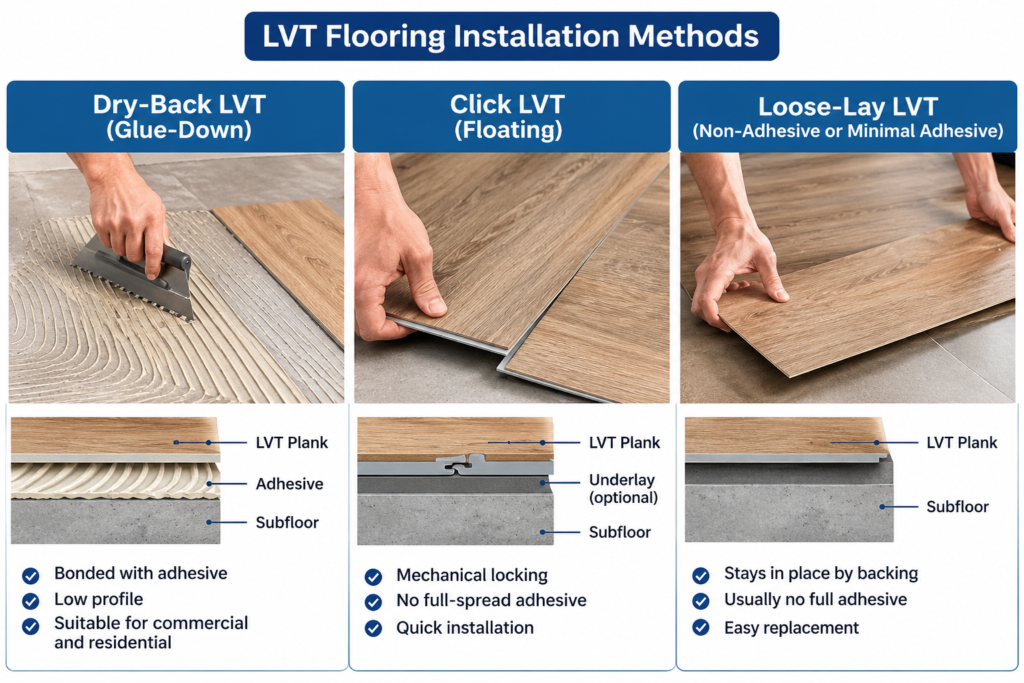
When comparing Dry-Back vs Click vs Loose-Lay LVT Flooring, the first thing to understand is how each system stays in position.
Dry-Back LVT is bonded directly to the subfloor with a suitable adhesive. Click LVT has locking profiles that connect one plank to the next, forming a floating floor.
Loose-Lay LVT uses a specially designed backing to create friction against the floor, reducing the need for conventional full-area adhesive.
The basic differences are outlined below.
| Item | Dry-Back LVT | Click LVT | Loose-Lay LVT |
|---|---|---|---|
| Installation method | Glue-down | Floating installation | Loose placement |
| Main fixing method | Adhesive bond | Mechanical locking | Backing friction |
| Full-spread adhesive | Normally required | Normally not required | Normally not required |
| Product construction | Flexible, usually thinner format | Locking-edge construction | Specially designed backing |
| Subfloor preparation | Essential | Essential | Essential |
| Installation process | Includes adhesive application | Planks are connected together | Planks are placed according to the installation instructions |
| Individual plank replacement | Usually involves removal and rebonding | May require partial disassembly | Often more straightforward |
| Common applications | Commercial and residential | Residential and selected commercial | Selected commercial and renovation projects |
These are general product characteristics, not universal installation rules. The manufacturer’s instructions should always take priority, especially where adhesive, room size or additional fixing requirements are concerned.
One point that sometimes causes confusion is Loose-Lay installation. It does not automatically mean that no adhesive is ever needed. Depending on the product and the installation area, perimeter adhesive or localized fixing may still be specified.
2. Dry-Back LVT: When a Direct Bond Makes More Sense
Dry-Back LVT, also called glue-down LVT, is installed directly onto the prepared subfloor using a suitable adhesive. The individual planks or tiles do not connect through locking profiles. Instead, the adhesive holds each piece in position.
It is a well-established installation method, particularly in commercial flooring. Dry-Back is also available in many residential designs, from wood-effect planks to stone-look tiles.
One reason it remains popular is its relatively low profile. In renovation projects, floor height can become a surprisingly troublesome issue. A new floor may affect door clearance, transitions between rooms or the fit of existing skirting boards. A thinner glue-down product can help keep these changes to a minimum, provided the existing substrate is suitable.
There is also flexibility in the way the floor is laid. Straight plank patterns, staggered layouts and various tile arrangements can be used without having to work around a floating click system.
The installation surface matters
Dry-Back is less forgiving when it comes to poor subfloor conditions.
Because the flooring is relatively thin and bonded directly to the substrate, surface imperfections may show through after installation. Dust, old adhesive residues and other contamination can also interfere with the bond.
Moisture needs attention as well. The concrete or other substrate must meet the requirements of the flooring and adhesive manufacturer. Applying adhesive to a floor that has not been properly checked can lead to problems later, even if the flooring itself meets the agreed specifications.
Installation involves more than simply spreading glue and placing the planks. The adhesive must be suitable for the product, applied at the recommended coverage rate and allowed to reach the correct working condition. Rolling and other installation steps should follow the manufacturer’s instructions.
This can mean more preparation and labor than a straightforward floating installation.
What to confirm before ordering
For Dry-Back LVT, the product specification and the installation system should be considered together. A useful quotation or technical discussion should cover:
Total thickness and wear layer.
Plank or tile dimensions.
Backing construction.
Recommended adhesive type.
Subfloor moisture and flatness requirements.
Installation and maintenance instructions.
Relevant product performance reports.
Adhesive compatibility is particularly important. Different backing materials and installation conditions may require different adhesive solutions. It is better to settle this before the product reaches the destination market than leave the contractor to work it out on site.
3. Click LVT: A Floating Floor with Locking Profiles
Click LVT joins individual planks through mechanical locking profiles along their edges. Once connected, the planks form a floating floor rather than being bonded individually to the subfloor.
The installation method will be familiar to many customers who have used laminate flooring. This familiarity is one reason Click LVT is often included in residential flooring ranges.
Still, the term Click LVT covers products with different constructions. Core materials, thicknesses, locking designs and attached underlays can vary considerably between manufacturers. Two products carrying the same general description may not offer the same installation experience.
Why it appeals to residential distributors
The lack of full-spread adhesive makes a standard floating installation relatively convenient. Installers can connect the planks without going through the adhesive application process required by Dry-Back.
Repairs may also be more manageable in certain situations. Depending on the locking design and the location of the damaged plank, the installer can dismantle the relevant section, replace the piece and reconnect the surrounding flooring.
For showroom sales, there is another practical advantage: the locking system is easy to demonstrate. Customers can see how the planks fit together rather than relying entirely on a product description.
Do not judge the locking system from a small sample
The locking profile deserves a proper inspection before bulk production.
A small sample may show the surface color and texture, but it reveals very little about how a full-length plank behaves during installation. Ask for several full-size pieces and connect them yourself, or have an installer test them.
Look for a few things:
Do the planks connect without excessive force?
Are the joints level once assembled?
Are there visible gaps between connected pieces?
Does the locking edge chip or show damage during assembly?
Can the connection be repeated consistently across several planks?
A profile that is difficult to assemble can slow down an installation. Uneven or damaged joints can also become a source of complaints after the flooring has been installed.
The subfloor should not be overlooked either. Floating flooring still needs a suitable, reasonably flat surface. Excessive unevenness can cause movement and put additional stress on the locking joints.
What about IXPE or EVA underlay?
Some Click LVT products have an attached IXPE or EVA backing. Others are supplied without an acoustic underlay.
This detail should be written clearly into the product specification. It affects the overall thickness, product construction and installation requirements.
Adding a separate underlay without checking the manufacturer’s recommendations is not a good idea. Some locking systems are designed for a particular level of support. An underlay that is too soft or compressible may allow excessive movement beneath the planks and place additional stress on the joints.
For OEM orders, it is worth confirming whether the backing is attached during production and recording its material and thickness in the approved specification.
4. Loose-Lay LVT: A Different Approach to Installation and Replacement
Loose-Lay LVT does not use the same mechanical locking system as Click LVT, nor does it normally rely on a full-area adhesive bond like Dry-Back.
Instead, the product is designed to stay in position through its own weight and the friction created by its backing against the subfloor. Some products use specially developed backing surfaces to improve contact and reduce movement.
The idea is straightforward, but the installation still needs care. A dusty, uneven or contaminated surface can affect how well the backing sits against the floor.
Where can Loose-Lay be useful?
One of the more practical reasons to consider Loose-Lay is maintenance.
Imagine a retail space where a plank is damaged by moving display equipment or a heavy object. With a suitable Loose-Lay system, the damaged piece may be lifted and replaced without dismantling a large section of the floor.
That can be useful for maintenance teams in offices, shops and selected commercial interiors. It may also suit certain renovation projects where access to individual sections is important.
The installation process can be relatively quick because there is no conventional full-spread adhesive application or mechanical locking between planks. However, the time saved will depend on the condition of the subfloor and whether the product requires additional fixing.
The important question is how well it stays in position
Loose-Lay products should not be treated as interchangeable. Their backing design, weight, dimensions and installation requirements all affect how they behave.
Areas with frequent turning movements, rolling loads or heavy foot traffic need particular attention. A product suitable for a small room may not be appropriate for a large open commercial space.
Depending on the manufacturer’s instructions, perimeter adhesive or localized adhesive may be required around doorways, transitions or other areas where movement is a concern.
Before placing an order, get clear answers to these questions:
Is the product designed for completely adhesive-free installation?
Is perimeter adhesive required?
Are there restrictions on room size or layout?
Is it suitable for rolling loads?
Which subfloor types are approved?
Can individual planks be lifted and replaced without damaging adjacent pieces?
Loose-Lay can add a useful option to an LVT range, but its selling points should be based on the actual product instructions rather than a general claim that it is simply easier to install.
5. Installation Cost: Which System Is More Economical?
There is no reliable answer based on the flooring price alone.
Dry-Back may have a competitive factory price, but the project also needs adhesive, preparation work and labor for installation. Click LVT normally avoids full-spread adhesive, although its product construction and locking system may affect the purchase price. Loose-Lay can reduce adhesive consumption, but some installations still need perimeter fixing or other materials.
A simple cost comparison looks like this:
| Cost factor | Dry-Back | Click | Loose-Lay |
|---|---|---|---|
| Flooring purchase price | Product-dependent | Product-dependent | Product-dependent |
| Adhesive | Usually full-area | Usually unnecessary | May be needed in selected areas |
| Underlay | Product-dependent | Product-dependent | Product-dependent |
| Floor preparation | Required | Required | Required |
| Installation labor | Includes adhesive work | Includes locking work | Depends on fixing requirements |
| Replacement work | Usually involves rebonding | May require disassembly | Often more straightforward |
| Additional materials | Adhesive and tools | Trims and transitions | Possible perimeter fixing materials |
For importers, it helps to separate two figures that are often mixed together during price comparisons.
Landed cost covers the product purchase price and the expenses involved in getting the goods to the destination market, such as packaging, freight, insurance and import duties.
Installed cost is what the end customer ultimately pays for the completed floor. It includes the flooring, substrate preparation, installation labor, adhesive or underlay where applicable, accessories and wastage.
A supplier offering a lower price per square meter does not necessarily provide the cheaper finished-floor solution. If a product takes longer to install or needs more preparation, that difference may quickly disappear.
For distributors, the most useful comparison is the total cost under the installation conditions common in their own market.
6. Residential vs Commercial Applications
The intended application should be clear before selecting the installation system. A product that works well in a residential showroom range may not be the right choice for a commercial specification.
Residential projects
Click LVT is often a practical option for residential distribution. Its floating installation method is familiar to many installers, and the locking system is relatively easy to demonstrate to customers.
Typical applications include:
Apartments and private homes.
Residential renovation.
Rental properties.
Retail flooring sales.
Selected interior refurbishment projects.
Loose-Lay may also be considered where replacing individual sections is important. Dry-Back remains an option when a low-profile finish is needed or when the installer is already experienced with glue-down flooring.
Commercial projects
Commercial flooring requires a closer look at the complete product specification.
Dry-Back LVT is commonly considered for offices, retail interiors and other spaces where a bonded installation is preferred. Click LVT can also be suitable for selected commercial applications, provided its construction and locking system meet the project requirements.
Loose-Lay may be useful in certain commercial renovation and maintenance settings, particularly where individual replacement is a priority.
There is no automatic link between an installation method and commercial performance. A click system is not necessarily more durable than a glue-down product, and a thicker product is not automatically suitable for heavier traffic.
Wear layer thickness, indentation resistance, dimensional stability, surface treatment and installation quality all need to be considered. The intended traffic level and project specification should guide the final selection.
7. Subfloor Preparation: A Requirement for All Three Systems
One common misunderstanding is that floating or Loose-Lay LVT can be installed over almost any existing floor.
It cannot.
The preparation requirements are different, but none of the three systems removes the need for a suitable substrate.
With Dry-Back, the surface must allow the adhesive to bond properly. With Click LVT, excessive unevenness can cause movement and put stress on the locking joints. With Loose-Lay, surface irregularities can prevent the backing from making consistent contact with the floor.
Concrete subfloors need particular attention. Moisture, surface contamination and flatness should be checked before installation begins.
The ASTM F710 standard for preparing concrete floors to receive resilient flooring provides guidance on concrete substrate preparation. Project-specific requirements and the flooring manufacturer’s instructions should also be followed.
Depending on the condition of the floor, preparation may involve moisture testing, removing old adhesive residues, repairing damaged areas or applying a suitable leveling compound.
For overseas projects, this is worth discussing with local installers before the flooring is imported. A shipment can arrive in perfect condition and still be held up because the site is not ready.
8. Comparing LVT Specifications Before Requesting a Quotation
When collecting quotations from several factories, avoid comparing products using only total thickness and price.
Two LVT products with the same stated thickness can have quite different constructions. A Click product needs a locking profile, while Loose-Lay may use a specially designed backing. Dry-Back has different installation requirements again.
A quotation should therefore include enough technical detail to identify exactly what is being offered.
Wear layer
Confirm the actual wear layer thickness. This is particularly important when comparing products intended for different traffic conditions.
Total thickness
Check whether the stated thickness includes an attached IXPE or EVA backing. Otherwise, two quotations may appear comparable when they are describing different constructions.
Backing construction
Find out whether the backing is designed for adhesive bonding, floating installation or Loose-Lay applications.
Locking profile
For Click LVT, request physical samples and check how the planks connect. The locking system should not be assessed from photographs alone.
Dimensional stability
Ask which test standard is used and what acceptance criteria apply. This information is useful when comparing products intended for markets with different temperature conditions.
Surface treatment
Confirm whether the product has a UV coating or another surface treatment. Any claims about scratch resistance, stain resistance or maintenance should be supported by relevant product information or test data.
Acoustic backing
If IXPE or EVA is included, record its material and thickness. Also confirm whether it is attached during production or supplied separately.
A complete specification sheet makes supplier comparisons much easier. More importantly, it gives both sides a clear reference when the bulk order is produced.
9. Sample Approval: Check the Construction, Not Just the Design
A flooring sample is often approved because the color and surface texture look right. That is understandable, but it is only part of the approval process.
The sample should represent the construction that will actually be supplied.
For Dry-Back LVT, check the total thickness, wear layer and backing. If possible, confirm that the product is compatible with the adhesive system recommended by the manufacturer.
For Click LVT, a single small sample is not enough. Request several full-length planks and assemble them. Check the locking edges, joint alignment and the amount of force needed to connect the pieces.
Loose-Lay needs a different kind of inspection. Pay attention to the backing surface and ask how the product should be installed in the intended room size and layout.
Surface appearance should also be checked under different lighting conditions. A wood grain that looks balanced on a small sample may appear quite different when repeated across a large floor area.
Once the sample is approved, put the agreed details into the purchase order. These should include:
Product dimensions and total thickness.
Wear layer specification.
Surface design and texture.
Backing construction.
Locking profile, where applicable.
Packaging details.
Installation requirements.
For OEM orders, keeping a signed or otherwise clearly identified reference sample is a practical way to check future production batches. It also helps avoid disagreements if the delivered goods do not match the original approval.
10. Sourcing Mistakes That Can Cause Problems Later
Many purchasing problems do not start with a major manufacturing defect. They begin with details that were never properly confirmed.
Comparing factory prices without considering installation costs
A lower price per square meter may look attractive, but adhesive, preparation and labor can change the overall calculation.
Assuming Loose-Lay is always adhesive-free
Some products require perimeter adhesive or localized fixing. The installation method needs to be confirmed for the specific product.
Overlooking the Click locking profile
A good-looking surface does not guarantee a reliable locking connection. Full-length samples should be assembled and checked before approval.
Treating every LVT product as suitable for commercial use
Commercial suitability depends on the full construction and relevant performance information, not simply whether the product is Dry-Back, Click or Loose-Lay.
Ignoring local installer experience
A system that sells well in one market may be unfamiliar to contractors in another. This can affect both product acceptance and installation costs.
Approving only the color
The approved sample should also represent the thickness, wear layer, backing and other construction details. Otherwise, the factory and buyer may be working from different expectations.
These checks are easier to complete before production. Once the goods have arrived at the destination port, correcting an unclear specification becomes much more difficult.
11. Which LVT Systems Should You Include in Your Product Range?
There is no need for every distributor to stock all three systems. The right range depends on the customers you already serve and the type of projects you want to develop.
A business focused mainly on residential flooring retailers may give Click LVT more shelf space. Distributors working closely with commercial contractors may have stronger demand for Dry-Back. Loose-Lay can be introduced as a more specialized option for customers who value easier replacement in suitable installations.
Local installation habits matter too. In some markets, contractors have years of experience with glue-down flooring. Elsewhere, floating click systems are more familiar, particularly in residential renovation.
Before committing to large stock quantities, it is useful to speak with local distributors and installers. Ask which systems they currently use, what problems they encounter and which product specifications their customers request most often.
The product range also needs to make sense commercially. Consider whether you can provide samples, installation information, packaging options and consistent specifications for repeat orders. These details can make a new product easier to introduce and support.
At SENOINFI, we work with international flooring buyers on LVT and other decorative flooring products. When developing an LVT range, the installation system is one of the details worth settling early, alongside thickness, wear layer, surface design and backing options.
Dry-Back, Click and Loose-Lay LVT are designed for different installation requirements. None is the right choice for every project.
Dry-Back is a practical option when a direct adhesive bond and low-profile construction are required. Click LVT offers a floating system familiar to many residential flooring buyers. Loose-Lay can be useful where individual plank replacement matters and the installation conditions suit the product.
For an importer, the decision should come down to the customers being served, the local installation practices and the total cost of the finished floor. A factory quotation is only one part of that decision.
If you are comparing LVT products for an upcoming order, start with the intended application and request samples that show the actual product construction. This makes it easier to compare suppliers on more than appearance and price.
For product specifications, surface designs and OEM options, visit SENOINFI LVT Flooring.