

When importing SPC flooring, thickness is one of the first specifications distributors, wholesalers, and project buyers need to decide.
Two of the most common options are 4mm SPC flooring and 5mm SPC flooring. Although the difference is only 1mm, it can affect product positioning, handling, installation conditions, cost, and the overall specification of the finished floor.
However, thicker does not automatically mean better.
For buyers, the right choice depends on the application, subfloor conditions, target market, expected traffic, wear layer, core construction, click system, and overall product specification.
This guide compares 4mm and 5mm SPC flooring from a B2B purchasing perspective and explains when each option may be appropriate.
What Does SPC Flooring Thickness Include?
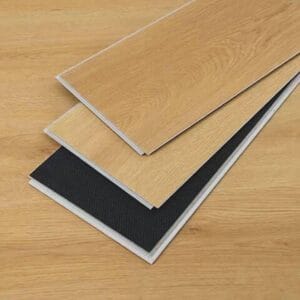
The total thickness of an SPC flooring plank normally consists of several layers:
- UV protective coating
- Wear layer
- Decorative film
- SPC rigid core
- Optional IXPE or EVA backing
Therefore, when comparing 4mm and 5mm SPC flooring, buyers should confirm exactly how the supplier defines total thickness.
For example, a product described as 5mm SPC flooring may include different wear layer and backing specifications.
Thickness alone does not determine product quality.
A well-manufactured 4mm floor with a stable core, accurate dimensions, suitable wear layer, and reliable click system can be more appropriate for a particular application than a thicker product with an unsuitable specification.
For a broader comparison of 4mm, 5mm, 6mm and 8mm products, see our SPC Flooring Thickness Guide.
4mm SPC Flooring: When Is It a Suitable Choice?
4mm SPC flooring is commonly considered for residential and cost-sensitive flooring programs.
Typical applications include:
- Apartments
- Bedrooms
- Living areas
- Rental properties
- Residential renovation
- Light commercial interiors
One reason buyers consider 4mm SPC flooring is its relatively efficient material usage and lower weight compared with thicker products.
For large-volume importers, product weight can also affect handling, transportation and container planning.
Potential advantages of 4mm SPC flooring
Depending on the complete product specification, 4mm SPC flooring can offer:
- Lower material consumption
- Lower product weight
- Easier handling
- Competitive positioning for cost-sensitive markets
- A wide range of decorative options
However, thinner flooring can place greater importance on subfloor preparation.
If the installation surface has significant unevenness or other problems, buyers should confirm whether the selected product is suitable for those conditions and follow the installation requirements provided by the manufacturer.
5mm SPC Flooring: A More Substantial Specification
5mm SPC flooring provides a thicker overall construction than 4mm flooring and is widely used across residential and selected commercial applications.
Typical applications may include:
- Residential developments
- Apartments
- Houses
- Offices
- Retail stores
- Hotels
- Showrooms
- Selected commercial projects
A common market specification is 5mm SPC flooring with a 0.3mm wear layer, although actual requirements vary between markets.
The wear layer, core construction, surface treatment, click profile and backing should always be specified separately rather than assuming that all 5mm products have the same performance.
Potential advantages of 5mm SPC flooring
Depending on construction, 5mm SPC flooring may provide:
- A more substantial plank structure
- Good balance between material cost and product specification
- Wider application flexibility
- Compatibility with different wear layer options
- Suitable positioning for many distributor product ranges
For importers looking for one relatively versatile specification for a market, 5mm SPC flooring can be considered alongside other thickness options.
4mm vs 5mm SPC Flooring: Key Differences
| Factor | 4mm SPC Flooring | 5mm SPC Flooring |
| Overall thickness | Thinner | Thicker |
| Product weight | Generally lower | Generally higher |
| Material cost | Generally lower | Generally higher |
| Handling | Easier | Slightly heavier |
| Subfloor requirements | More important to control | Still requires proper preparation |
| Product positioning | Cost-conscious | More substantial / versatile |
| Common applications | Residential, renovation | Residential, retail, selected commercial |
| Wear layer | Can be customized | Can be customized |
| Backing | IXPE/EVA options | IXPE/EVA options |
| Click system | Specification dependent | Specification dependent |
The table provides general purchasing guidance. Actual performance depends on the complete construction and manufacturing quality of the product.
Is 5mm SPC Flooring Always Better Than 4mm?
Not necessarily.
A common mistake among buyers is to treat thickness as the single indicator of quality.
In reality, several specifications work together.
1. SPC Core
The rigid core contributes to the structural characteristics of the plank.
Buyers should pay attention to:
- Material formulation
- Density
- Thickness consistency
- Dimensional stability
- Production consistency
2. Wear Layer
The wear layer protects the decorative surface against everyday abrasion.
For example, 4mm SPC flooring with a 0.5mm wear layer and 5mm SPC flooring with a 0.2mm wear layer are not directly equivalent products.
The wear layer should therefore be specified separately.
See our SPC Flooring Wear Layer Guide for a more detailed explanation of 0.2mm, 0.3mm, 0.5mm and 0.7mm options.
3. Click System
The quality and precision of the locking profile can affect installation and joint performance.
Buyers should check:
- Edge accuracy
- Locking consistency
- Joint alignment
- Installation performance
- Dimensional tolerances
A thicker plank does not compensate for a poorly controlled click profile.
4. Backing
Some SPC products include attached IXPE or EVA backing.
Backing specifications should include:
- Material
- Thickness
- Coverage
- Adhesion
- Consistency
Backing should be considered as part of the complete product construction rather than simply an additional accessory.
Which Is Better for Residential Projects?
Both 4mm and 5mm SPC flooring can be used for residential applications.
The choice depends on the target market and product positioning.
4mm may be considered when:
- Cost competitiveness is important
- The project has suitable subfloor conditions
- Lower product weight is useful
- The product is positioned toward entry or mid-range residential markets
5mm may be considered when:
- A more substantial product specification is preferred
- The product needs broader application positioning
- The distributor wants a specification suitable for different residential projects
- Cost and product construction need to be balanced
The final decision should be based on the complete specification rather than thickness alone.
Which Is Better for Commercial Projects?
For commercial projects, buyers should not select flooring based only on 4mm versus 5mm.
Other specifications may be more important depending on the project:
- Wear layer
- Core construction
- Click system
- Surface protection
- Fire performance requirements
- VOC requirements
- Dimensional stability
- Maintenance requirements
- Installation conditions
For example, a hotel, retail store, office and residential apartment may have different performance requirements.
For larger projects, buyers should establish a written product specification before requesting quotations.
You can also refer to our guide on SPC Flooring for Commercial Projects for a broader project specification framework.
How Does Thickness Affect SPC Flooring Cost?
Thickness is one of the factors that can influence factory pricing.
Generally, a thicker product requires more raw material and may therefore have a higher manufacturing cost.
However, the final quotation also depends on:
- Wear layer
- Core formulation
- Plank dimensions
- Decorative film
- Embossing
- EIR surface
- Click system
- IXPE or EVA backing
- Packaging
- Order quantity
- OEM requirements
Therefore, asking a supplier simply:
“What is your price for 5mm SPC flooring?”
may not produce a meaningful comparison.
A better RFQ should specify the complete construction.
For example:
5mm SPC + 0.3mm wear layer + specific plank size + EIR surface + IXPE backing + required click profile + packaging specification
This makes quotations much easier to compare.
How Should Importers Choose Between 4mm and 5mm?
A practical purchasing process can follow these steps.
Step 1: Define the application
Determine whether the flooring will be used for:
- Residential
- Rental housing
- Retail
- Office
- Hotel
- Multifamily
- Other commercial projects
Step 2: Check the subfloor
Evaluate the installation surface and determine whether additional preparation is required.
Step 3: Define the wear layer
Do not compare products based only on total thickness.
Specify the required wear layer according to the intended application.
Step 4: Compare the complete construction
Check:
- Core
- Thickness
- Wear layer
- Surface
- Click system
- Backing
- Dimensions
- Packaging
Step 5: Compare landed cost
For international buyers, the purchase price is only one part of the total cost.
Consider:
- Factory price
- Product weight
- Container loading
- Freight
- Packaging
- Import costs
- Installation requirements
Step 6: Test samples
Before placing a large order, buyers should compare samples and confirm the approved specification with the supplier.
4mm or 5mm SPC Flooring: A Simple Buyer Guide
For a quick purchasing reference:
Choose 4mm when:
the target market is cost-sensitive, the installation conditions are suitable, and lower product weight and material cost are important considerations.
Choose 5mm when:
the buyer wants a more substantial specification with broader positioning across residential and selected commercial applications.
But neither option should be selected based on thickness alone.
For professional buyers, core quality + wear layer + click system + surface + backing + manufacturing consistency should be evaluated together.
What Should You Ask Your SPC Flooring Supplier?
Before placing an order, importers can ask the supplier:
- What is the exact total thickness?
- What is the wear layer thickness?
- What is the core construction?
- What click system is used?
- Is IXPE or EVA backing available?
- What are the dimensional tolerances?
- What test reports are available?
- Can the factory provide production samples before shipment?
- What packaging options are available?
- Can the same specification be maintained for repeat orders?
These questions help buyers compare suppliers on more than price alone.
For a broader supplier evaluation process, see our SPC Flooring Supplier Checklist.
4mm and 5mm SPC Flooring from SENOINFI
SENOINFI Flooring supplies SPC flooring in approximately 3.5mm to 8mm thicknesses, with different wear layer options depending on product requirements.
For importers and distributors, specifications can be discussed according to:
- Target market
- Product thickness
- Wear layer
- Decorative design
- Surface texture
- Click system
- IXPE/EVA backing
- Packaging
- OEM requirements
Instead of selecting a thickness only by price, buyers can first define the intended application and required specification, then compare suitable product constructions.
If you are sourcing 4mm or 5mm SPC flooring for distribution or projects, SENOINFI can provide product specifications, samples and quotation options based on your requirements.
Contact SENOINFI Flooring to discuss your required SPC flooring specification.