


A common question is:
Is thicker SPC flooring always better?
Not necessarily.
The right SPC flooring thickness depends on the application, subfloor condition, product construction, expected traffic, installation system, target market, and overall specification. For example, a well-manufactured 5mm SPC floor with a suitable rigid core, reliable click system, and appropriate wear layer may be a better choice for a particular project than simply selecting the thickest available product.
This guide compares 4mm, 5mm, 6mm, and 8mm SPC flooring and explains how buyers can select the appropriate specification for different markets.
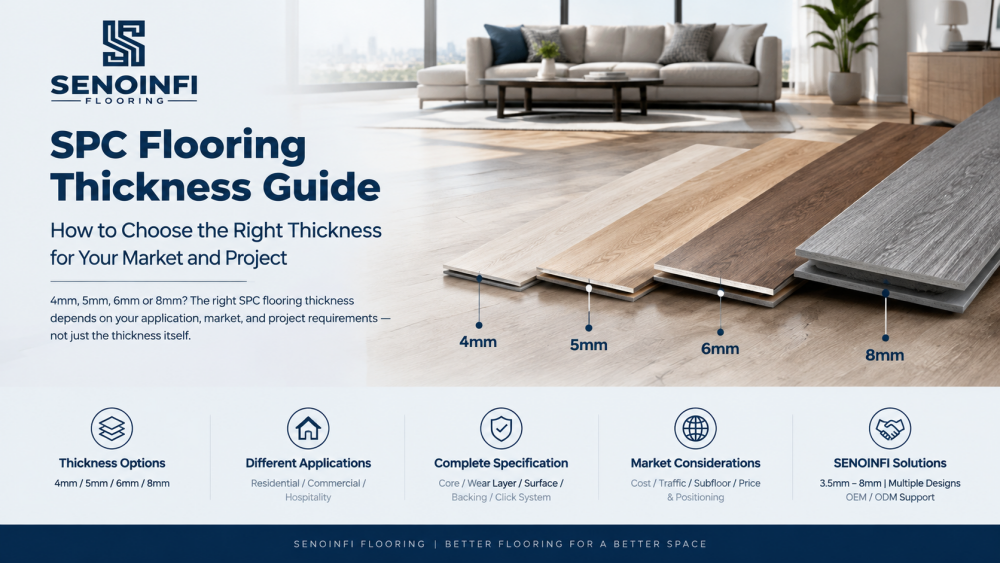
What Does SPC Flooring Thickness Include?
The total thickness of an SPC flooring plank can include several layers:
UV protective coating
Wear layer
Decorative film
SPC rigid core
IXPE or EVA backing, if included
Therefore, when comparing quotations from different suppliers, buyers should confirm how the quoted thickness is measured. Two products both described as “5mm SPC flooring” may have different constructions and layer configurations.
For professional sourcing, thickness should always be evaluated together with the complete product specification. For an overview of SPC flooring construction, see our SPC Flooring Technical Guide.
1. 4mm SPC Flooring: A Practical Option for Cost-Sensitive Projects
4mm SPC flooring is commonly considered for residential and renovation projects where product cost, handling, and transportation efficiency are important.
Typical Applications
Apartments, bedrooms, and living rooms
Rental properties and residential renovations
Selected light commercial applications
Potential Advantages
A 4mm construction can offer lower material consumption, reduced product weight, easier handling, efficient transportation, and competitive positioning for cost-sensitive markets. For large-volume importers, product weight can also affect transportation and container planning.
However, thinner SPC flooring places greater importance on subfloor preparation. If the installation surface is uneven or does not meet the manufacturer’s requirements, installation performance can be affected. Buyers should not select 4mm flooring based on price alone; the complete construction and installation conditions must be considered.
To evaluate lightweight specifications further, review our 4mm SPC Flooring Wholesale Specifications.
2. 5mm SPC Flooring: A Balanced Specification
5mm SPC flooring is widely used across residential and commercial-oriented markets because it offers an optimal balance between product construction, handling, performance requirements, and cost.
Typical Applications
Residential developments, apartments, and houses
Offices, retail stores, hotels, and showrooms
A common market specification is 5mm SPC flooring with a 0.3mm wear layer, although the actual specification can vary by market and application. Depending on the supplier, buyers may also select different wear layers, surface finishes, decorative designs, backing materials, and click systems. For distributors looking for a versatile mainstream specification, 5mm is a practical option to evaluate.
For a more detailed discussion, see our 5mm SPC Flooring Commercial Benchmark Guide.
3. 6mm SPC Flooring: More Substantial Product Construction
6mm SPC flooring provides a thicker overall construction than 4mm and 5mm options. It may be considered for projects where buyers prefer a more substantial floor profile or where the product is positioned toward the premium residential or commercial segment.
Typical Applications
Premium apartments, hotels, and offices
Retail spaces and high-end residential interiors
However, buyers should not assume that 6mm automatically provides better performance than every thinner product. Important factors still include core construction, core density, click-lock quality, wear layer, surface technology, plank dimensions, and installation requirements. Thickness is one specification, not a complete measure of product quality.
4. 8mm SPC Flooring: Premium Positioning
8mm SPC flooring represents the thicker end of the common SPC flooring range, selected for premium residential projects, hospitality interiors, and commercial applications where a substantial product profile is preferred.
Potential Applications
Luxury residential projects and high-end apartments
Boutique hotels and premium commercial interiors
A thicker construction provides a distinct underfoot feel and product positioning. However, it also generally involves higher material consumption, greater product weight, and potentially higher transportation costs. For this reason, 8mm should be selected according to the positioning of the project rather than simply because it is the thickest option.
4mm vs. 5mm vs. 6mm vs. 8mm SPC Flooring Comparison
| Thickness | Typical Market Position | Main Considerations |
| 4mm | Cost-sensitive residential and renovation | Lightweight, transportation efficiency, subfloor preparation |
| 5mm | Mainstream residential and selected commercial | Balanced specification and broad application range |
| 6mm | Premium residential and commercial | More substantial construction and premium positioning |
| 8mm | Premium and luxury projects | Thicker construction, higher weight and material consumption |
Note: This table should be treated as a general sourcing reference, not a universal application rule. The appropriate specification depends on actual product construction and project requirements.
Does Thicker SPC Flooring Mean Better Quality?
This is one of the most important questions for importers. No. Thickness alone does not determine SPC flooring quality.
A flooring product should be evaluated as a complete system, comparing the following key components:
Rigid Core: The core is an important structural component. Its formulation, consistency, and dimensional characteristics affect overall stability.
Wear Layer: Protects the decorative surface against everyday abrasion (common options: 0.2mm, 0.3mm, 0.5mm, 0.7mm). Read our SPC Flooring Wear Layer Guide.
Click System: Important for installation and joint performance. See our SPC Flooring Click System Guide.
Backing: IXPE or EVA backing affects walking comfort, acoustics, and installation. See IXPE vs EVA Underlayment for SPC Flooring.
How Should Importers Choose SPC Flooring Thickness?
Rather than asking, “Which thickness is the best?”, a better question is: “Which thickness and construction are appropriate for my market and application?”
Consider these five core factors:
Target Market: Cost-sensitive vs. premium flooring markets.
Application: Residential, rental housing, offices, retail, or hotels.
Subfloor Conditions: Thinner flooring places greater importance on subfloor flatness and cleanliness.
Expected Traffic: Matched with wear layer and overall construction.
Target Price & Positioning: Evaluating the complete package (Thickness + Wear Layer + Surface + Backing + Click System + Packaging + Price).
What Should Buyers Ask an SPC Flooring Manufacturer?
Before requesting quotations, importers should provide suppliers with a clear specification covering total thickness, wear layer, plank dimensions, core construction, surface finish, click system, backing material, packaging, required documentation, and target application.
Comparing “5mm SPC flooring” against another supplier’s “5mm SPC flooring” does not mean the products are equivalent. The wear layer, core, surface, backing, click profile, and testing documentation may all differ.
SPC Flooring Thickness at SENOINFI
SENOINFI offers SPC flooring specifications covering approximately 3.5mm to 8mm, with different wear layer and surface configurations for diverse market requirements. Available options include:
4mm, 5mm, 6mm, and 8mm SPC flooring
Multiple wear layer specifications
Wood and stone designs
EIR surface options
IXPE/EVA backing options
Certified click-lock configurations
Contact SENOINFI to discuss the appropriate SPC flooring thickness and construction for your project or distribution market.