


For international flooring importers, distributors, and project developers, nothing is more frustrating than approving a flawless showroom sample, receiving a bulk container, and discovering that the bulk production or subsequent reorder differs in color shade, gloss level, click fit, or core density.
In B2B flooring procurement, maintaining strict SPC flooring batch consistency is a critical benchmark of a manufacturer’s quality control maturity. Because rigid core luxury vinyl flooring involves complex polymer chemistry, mineral powder compounding, high-temperature extrusion, and precise digital printing, slight variations between production runs can occur if strict manufacturing controls are not enforced.
This comprehensive guide explains why batch variations happen, how to evaluate production stability, and what importers can do to ensure samples, bulk orders, and reorders match perfectly through rigorous SPC flooring batch consistency protocols. Before diving into color matching, it is also essential to understand the overall engineering; you can review our foundational SPC Flooring Technical Guide for deeper context.
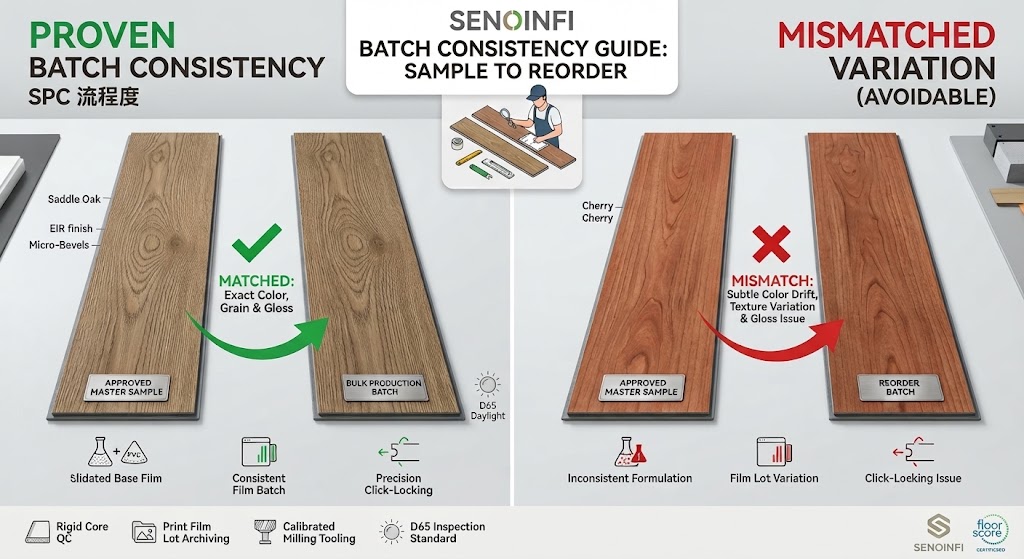
Why Batch Consistency Matters in SPC Flooring Sourcing
When supplying flooring for multi-family residential developments, large commercial spaces, or nationwide retail distribution, consistency is mandatory. If a project requires additional material halfway through installation (or months later for maintenance replacement), a mismatched reorder can result in visible seams, color blocks, and costly project disputes. Ensuring absolute SPC flooring batch consistency safeguards your brand reputation.
When scaling projects across multiple units or container loads, buyers must also evaluate dimensional standards. For insights on multi-unit project sourcing, check out our guide on [suspicious link removed]. Furthermore, international quality compliance is often benchmarked against guidelines provided by organizations like ASTM International for resilient flooring performance.
1. Common Causes of Batch Variations in SPC Flooring
Understanding why inconsistencies happen helps importers ask the right questions during factory audits and supplier selection:
Raw Material Variations: SPC cores are primarily composed of PVC resin and natural limestone powder[cite: 4]. Shifts in the purity or particle size of raw materials can subtly alter the base color, weight, and flexural strength of stock. For structural performance comparisons, you can compare rigid core structures with our SPC vs LVT vs Laminate Flooring Guide.
Printing and Film Tolerances: Decorative wood or stone films are printed in runs. If a supplier changes film suppliers or printing cylinders between batches, grain sharpness, hue, and undertones can drift.
Surface Gloss and UV Coating Curing: The final UV protective layer dictates surface sheen (matte vs. satin). Variations in UV lamp curing speed or chemical formulation can alter the gloss level, making floors look lighter or shinier under different lighting conditions.
Milling Tooling Wear: The click-lock profile (such as Unilin or I4F systems) is cut using diamond-tipped profiling machines. As cutting heads wear down over time, locking tolerances can shift, leading to loose joints or difficult installation in reorders.
2. How to Ensure Master Samples Match Bulk Production
The consistency process begins long before the container leaves the port. Importers should establish a strict sample verification protocol:
Sign and Retain Master Samples: Always request three identical sets of production samples for every new design and color. One set goes to your office, one stays with the factory as the “Golden Master Sample,” and one travels with your third-party inspector.
Confirm Technical Data Sheets (TDS): Ensure that thickness, wear layer thickness, density, and peeling strength are explicitly written into the contract. For standard thickness benchmarks, read our SPC Flooring Thickness Guide. For details on protective surfaces, read our SPC Flooring Wear Layer Guide.
Inspect Under Standardized Lighting: When reviewing pre-production samples (PPS), evaluate them under standardized D65 daylight bulbs or light boxes rather than variable office lighting to catch subtle undertone variations early.
3. Managing Reorders and Future Batch Continuity
Reorders are where many buyers run into trouble because months may have passed since the original container was shipped. To protect your supply chain on repeat orders and guarantee long-term SPC flooring batch consistency:
Reference the Original Batch Number: Always quote the original production batch number or order reference when placing a reorder. Reliable manufacturers archive historical production parameters, film batch records, and core formula ratios.
Request a Pre-Production Sample (PPS) for Large Reorders: If you are placing a massive repeat order for a commercial project, request a fresh cutting sample from the upcoming production run before the entire factory line rolls.
Evaluate Click-Lock Performance: For click systems, verify that milling precision remains identical so installers don’t experience height discrepancies (lippage) when mixing older stock with new containers. Read more about locking mechanics in our SPC Flooring Click System Guide.
4. What Questions Should Buyers Ask SPC Flooring Manufacturers?
Before committing to long-term distribution agreements, importers should vet their manufacturing partners using targeted quality control questions:
How do you manage raw material compounding consistency for repeat orders?
Do you archive signed master samples and decorative film batches for future matching?
What is your protocol for monitoring gloss levels and color variations during continuous extrusion?
How frequently are click-profiling milling heads inspected and replaced?
For a complete pre-shipment verification and loading checklist, review our SPC Flooring Quality Inspection Checklist.
SPC Flooring Batch Consistency at SENOINFI
At SENOINFI, we understand that global distributors and project developers rely on absolute predictability. Our manufacturing infrastructure is engineered to safeguard SPC flooring batch consistency through:
Strict Raw Material Auditing: Automated weighing and mixing systems for rigid core compounds to maintain stable density and structural rigidity.
Archived Master Controls: Rigorous sample archiving and batch-code tracking for all wood-grain films, EIR textures, and wear layers.
Precision Milling & Rigorous QC: Advanced profiling machinery subject to strict calibration schedules, backed by multi-stage quality inspections before container loading.
Whether you are launching a new private label collection or scaling repeat distribution inventory, SENOINFI provides dependable manufacturing support[cite: 5]. Contact us today to discuss your specifications, request standardized samples, or audit our production capabilities.