

For international flooring importers, distributors, and general contractors, managing quality risks before container dispatch is the single most critical factor determining operating profit.
When full container loads (FCL) of rigid core flooring arrive at overseas discharge ports, finding dimension variance, loose locking tongues, or wear layer degradation makes return logistics economically impossible.
A comprehensive pre-shipment quality control protocol bridges the gap between approved pre-production samples and mass container output.
Following an established SPC flooring quality inspection checklist across physical measurements, mechanical properties, and packaging standards protects overseas buyers from catastrophic jobsite claims.
For an overview of comprehensive manufacturing standards and direct production capabilities, explore our SPC Flooring Wholesale and Manufacturing Solutions.
1. Pre-Shipment Physical Dimensions & Tolerance Inspection
Precision tolerances prevent cumulative misalignment across large installation spans. A factory QC inspection must sample finished planks across multiple production lines using high-precision digital calipers and optical gauges.
Total Thickness & Layer Stratification
Total plank thickness must be evaluated at nine independent points per plank (three at each end and three in the center). For a standard commercial board, variations must not exceed ±0.10mm. Importers should carefully cross-reference specifications outlined in our SPC Flooring Thickness Guide: How to Choose 4mm, 5mm, 6mm or 8mm to verify core height versus acoustic pad thickness.
Wear Layer Thickness & Lamination Bond
Suppliers may downgrade transparent wear layers to reduce cost (e.g., substituting 0.20mm for a contracted 0.30mm). QC inspectors should verify the clear PVC layer using a cross-sectional optical micrometer. Refer to our SPC Flooring Wear Layer Guide: 0.2mm vs 0.3mm vs 0.5mm vs 0.7mm to confirm standard commercial wear thickness requirements. Additionally, scratch and peel tests should follow rigorous ASTM guidelines accessible via ASTM International standards .
Squareness, Straightness, and Edge Deviation
Squareness: Deviations at plank corners must remain within <= 0.25mm to prevent running stair-step offsets during staggered floating installation.
Edge Straightness (Camber): Longitudinal edge curvature along the plank length must not exceed 0.20mm per meter.
Height Lippage: Installed step differences between adjacent boards must remain strictly within <= 0.10mm.
2. Material Composition: Virgin Limestone Core vs. Recycled Scrap
The rigid core formula directly governs indentation resistance, thermal stability, and long-term acoustic performance.
Fracture Color and Density
Snap a production plank manually or slice the core edge with a carbide blade to inspect the core interior:
100% Virgin Core: Exhibits a uniform, dense, ivory-white or light-grey grain with microscopic, even distribution of PVC resin and calcium carbonate (CaCO3). Bulk density consistently registers between 1,950 kg/m³ and 2,100 kg/m³.
Recycled Scrap Core: Exhibits dark grey or black speckles, porous voids, and brittle fracture planes caused by degraded thermal stabilizers.
Chemical Safety and VOC Emissions
Cores manufactured with contaminated industrial scrap often fail strict indoor air quality mandates. Professional importers must demand lot-specific emission verification. Review our analysis on Is SPC Flooring Safe? Formaldehyde, VOC and Environmental Standards, and ensure batch documentation holds verified FloorScore indoor air quality certification (External Link).
3. Click-Lock Profiling Precision and Mechanical Tensile Testing
Milling profile tolerances determine seam tightness, water-resistance integrity, and ease of contractor installation. Understanding how to inspect SPC flooring quality ensures the locking mechanism performs reliably in the field.
Dry-Fit Assembly and Joint Tolerance
Assemble a test grid of four planks on a verified granite inspection flat. Inspect engagement behavior:
The tongue must slide or drop into the groove smoothly without requiring excessive mallet force that could fracture the lower lip.
Seam gap spacing across connected planks must remain within <= 0.15mm under standard ambient conditions.
For a deeper breakdown of locking mechanics, see our SPC Flooring Click System Guide: How Locking Technology Improves Installation and Performance.
Laboratory Pull Force Strength (ISO 24334)
Factory laboratory testing should verify mechanical tensile resistance using calibrated pull-bench equipment under ISO international standards (specifically ISO 24334) (External Link). Commercial-grade profiles must withstand horizontal tension ≥ 2.0 kN/m along the long edge and ≥ 3.0 kN/m along the short edge before joint separation or core shearing occurs.
4. Acoustic Underlayment & Surface Performance Testing
Evaluating the integrated backing and surface wear finish confirms durability in heavy-traffic facilities.
Acoustic Pad Adhesion and Density
Pre-attached IXPE underlayment must be fused uniformly to the rigid core without blistering or corner peeling. Ensure the backing density meets commercial specifications (≥ 100 kg/m³) as detailed in our guide to IXPE vs EVA Underlayment for SPC Flooring. High-density IXPE prevents locking fatigue under continuous point loads.
Cured UV Topcoat and Scratch Resistance
Test the factory-applied PUR coating infused with ceramic micro-beads. Perform a coin-scratch test and apply common staining agents (coffee, isopropyl alcohol, mustard, mineral oil) for 24 hours. The surface must wipe clean without residual ghosting or loss of matte sheen.
5. Packaging, Palletization, and Ocean Container QC
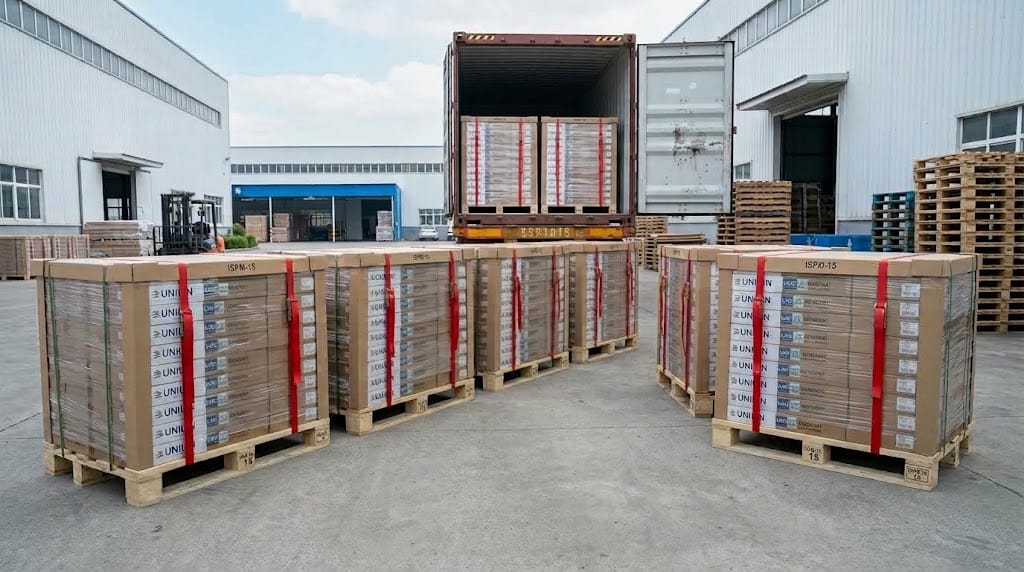
Improper palletization causes crushing, broken locking tongues, and structural collapse during multi-week ocean transit.
| Inspection Point | Mandatory Quality Standard | Critical Risk Mitigated |
| Pallet Construction | Solid-top heat-treated wooden pallets (ISPM-15 compliant) with plywood buffer sheets. | Bottom plank tongue damage from pallet slat gaps. |
| Edge Protection | Heavy-duty V-board paper corner protectors covering the entire pallet height. | Strap-cutting crush marks on outer cartons. |
| Wrapping & Strapping | 6+ layers of high-tensile stretch film with at least four vertical polyester straps. | Pallet shifting and collapse under vessel rolling motion. |
| Patent Holograms | Verifiable Unilin or i4F L2C holographic stickers affixed to each box. | Customs seizures and IP patent infringement penalties. |
For step-by-step weight distribution and loading calculations, refer to our comprehensive SPC Flooring Container Loading and Ocean Freight Guide.
Pre-Shipment Inspection Checklist Summary
Before releasing final balance payments for your container orders, ensure your QC team or third-party inspection agency confirms the following:
Total plank thickness, core depth, and wear layer meet contract TDS tolerances within ±0.10mm.
Core fracture shows 100% virgin limestone-polymer matrix with no dark regrind contamination.
Dry-fit assembly confirms tight seams (<= 0.15mm) with zero surface lippage binding.
Acoustic IXPE underlayment is firmly laminated and delivers required impact noise isolation.
Official patent labels are visibly applied to every export box for seamless customs clearance.
At SENOINFI, every container of SPC flooring undergoes complete internal quality assurance with standardized testing records, thickness checks, and container-loading photo documentation provided before vessel departure. Contact our commercial engineering team today to review technical data sheets and request factory sample boxes.