


When you are managing a commercial project rollout or distributing a container of rigid core flooring to regional dealers, the last thing you want to hear is a frantic phone call from a job site: The seams are peaking, the click joints are snapping, or the floor is sounding hollow and cracking underfoot.
In the flooring business, installation failures are rarely just technical glitches. For contractors, a failed floor means destroyed credibility in front of clients. For importers, it triggers an exhausting cycle of overseas blame-shifting, expensive warranty claims, and the lingering, uncomfortable fear that your product selection was a mistake. Because rigid core luxury vinyl is less forgiving of subfloor flaws than traditional materials, minor oversights during installation can quickly turn into multi-thousand-dollar disasters.
To protect your margins and save your reputation, here are five costly SPC flooring installation mistakes that importers, distributors, and general contractors must actively prevent. Before diving into installation pitfalls, it is also essential to understand the overall engineering; you can review our foundational SPC Flooring Technical Guide for deeper context.
1. Ignoring Subfloor Flatness and Deflection Tolerances
The single most common root cause of SPC flooring installation mistakes and overall structural failure is the assumption that hard, rigid SPC planks can flatten out an imperfect subfloor. They cannot.
Unlike flexible LVT or carpet, SPC features a dense limestone-and-PVC rigid core. If the subfloor has low spots exceeding standard tolerances (typically exceeding 3/16 inch per 10 feet), the plank has no material give. When heavy foot traffic or rolling loads pass over that unsupported void, the click-lock tongue and groove takes the bending stress—and snaps.
Furthermore, international quality compliance for resilient surfaces is often benchmarked against guidelines provided by organizations like ASTM International to ensure proper structural performance.
The Reality Check: Installers often try to rush past self-leveling compounds to save time. As an importer or contractor, you must enforce strict pre-installation site checks. To avoid these SPC flooring installation mistakes, you can also compare rigid core structures with our SPC vs LVT vs Laminate Flooring Guide.
2. Restricting Thermal Expansion (The Pinch Point Error)
Many installers treat SPC flooring as if it can be glued or pinned down like traditional tile or hardwood. Because SPC is a floating floor system, individual planks expand and contract slightly with ambient temperature shifts, especially in spaces with large floor-to-ceiling glass windows or direct sunlight.
Pinning the floor under heavy, fixed kitchen islands, cabinetry, or slamming heavy baseboards directly down onto the surface strips away its freedom to move. When the floor tries to expand and hits a hard wall or fixed fixture, it has nowhere to go but up—resulting in tenting, buckling, and popped seams.
Prevention Tip: Always maintain proper perimeter expansion gaps (usually at least 1/4 inch) and never install heavy stationary cabinetry directly on top of floating rigid core flooring. When scaling projects across multiple units or container loads, buyers must also evaluate dimensional standards; check out our guide on [suspicious link removed].
3. Forcing Damaged Click-Lock Profiles During Installation
Another critical area among common SPC flooring installation mistakes involves installers forcing misaligned planks using excessive mallet force or dirty locking grooves.
If microscopic debris or sand gets trapped inside the click channel during installation, or if the installer forces a joint at the wrong angle, the delicate polymer lip of the profile shears off. It might hold together during the final walk-through, but two weeks later under regular traffic, that compromised joint separates, creating a sharp ridge that catches shoes and ruins the room.
Quality Control: Sourcing from manufacturers with precise milling tooling is critical. Learn more about how click engineering prevents these SPC flooring installation mistakes in our SPC Flooring Click System Guide.
4. Overlooking Moisture Mitigation and Improper Underlayment Stack
While SPC cores are 100% waterproof and won’t rot like wood, subfloor moisture vapor emission is still a massive hazard. Laying rigid core directly over fresh, un-cured concrete without a proper vapor barrier allows trapped alkaline moisture to attack adhesives, promote mold under attached IXPE pads, or cause dimensional issues in adjacent building materials.
Furthermore, doubling up on underlayments (e.g., placing an extra rubber roll underneath an SPC plank that already features an integrated IXPE/EVA pad) creates excessive vertical deflection. This over-bends the locking mechanism with every step.
Proactive Sourcing: Ensure your technical data sheets specify correct underlayment pairing. For standard thickness benchmarks, read our SPC Flooring Thickness Guide. For a detailed breakdown on pads, read our analysis on IXPE vs EVA Underlayment for SPC Flooring.
5. Falling into the “Blame Game” Trap When Claims Happen
When an installation fails six months down the road, a toxic cycle of finger-pointing immediately begins:
The end-client blames the general contractor.
The contractor blames the installation crew.
The installation crew blames the distributor.
The distributor scrambles to call the overseas manufacturer, who points out a clause in the warranty stating “failure due to improper subfloor preparation or lack of expansion gaps.”
This leaves the importer or local contractor holding the financial and emotional bag—trapped in a vacuum of responsibility with zero institutional backing. Preventing this requires bulletproof transparency from day one. Before shipping containers, verify that your supplier provides clear, enforceable technical documentation.
For a step-by-step verification framework, consult our SPC Flooring Quality Inspection Checklist.
Partnering with SENOINFI for Project Peace of Mind
At SENOINFI, we know that importers and contractors don’t just buy flooring; they buy risk mitigation. You need products that install predictably, perform under real-world commercial stress, and come backed by a supply chain partner who doesn’t disappear when questions arise.
Our manufacturing controls are engineered to eliminate uncertainty:
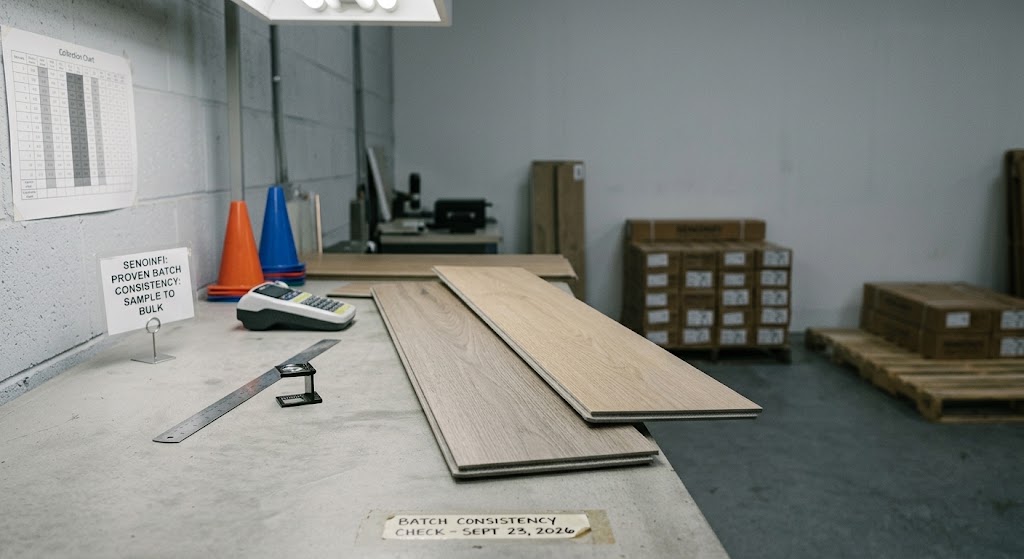
Precision-Milled Click Profiles: Rigorous calibration schedules ensure consistent locking geometry across every container load.
Stable Core Formulations: Engineered limestone-and-PVC ratios designed to withstand normal structural shifts without brittle failure.
Transparent Technical Support: Clear installation guidelines and dedicated assistance to help your local contractors avoid costly callbacks.
Don’t let avoidable SPC flooring installation mistakes drain your project margins or damage your market reputation. Contact SENOINFI today to request reliable samples, review our technical specifications, and secure your next flooring project with absolute confidence.